There are some things you do because you have to. Work. Bills. More work.
Then there are the things you do, like breathing, because they are a part of you. You don’t always know how much a part of you there, until you have time to take a deep breath, and exhale and realize how long it’s been since you last doc a good, restorative breath.
I’ve been painting more nights, but not lately, and the last few nights, I realize that it’s not until the palette is good and messy, that, often for the first time each day, I am breathing normally.
I’ll keep doing the things I have to do. Working. Paying bills. But I know, one of these days, I will find a way to make a breathing the main priority.
I’ve heard that over and over, and, yet, for a few months of focus, of clarity, I let myself believe I was cured.
But as soon as fall brought sniffles and crazy weather, my meniere’s brought fog. The fog brought fear, and the fear brought the panic that my life as a teacher was over.
The fog keeps me from standing without falling, from driving, from doing all the things teachers have to do in a normal year, and — as most teachers will tell you – the last few years have been anything but normal or even sustainable for a healthy body.
Panic is the enemy of good decisions. It tells me to go back to technology, to find a way to work at home for more money, for security. Panic, in the guise of planning and over-planning, has me applying for safety jobs I don’t need yet. Most of all, it keeps me from staying focused on the one thing — my art – that has the power to get me through the fog.
Today, while I was at work strategizing how to keep all my very full plates in the air, a neighbor recommended to my husband a movie on Netflix called American Symphony. I have grades and a paper to finish, but we decided to take a break and watch it. Ostensibly the movie is a documentary of composer John Batiste’s journey from band camp to band leader of the Late Show to a Best Album of the Year Grammy win in 2021 against the backdrop of his wife’s battle with leukemia. At its heart, the movie is a clarion call to all artists to focus on the work, of that creative spark within that matters more than money or likes or accolades. Art, in all its form, as Batiste exclaims in his acceptance speech, is there to “reach [a] person at a point in their lives when they need it most.”
I burst into tears at those words, knowing that the way out of the fog is to shed all the concerns that distract in the name of survival and get back to fanning the creative spark that will get me through school and work even when I’m literally falling down.
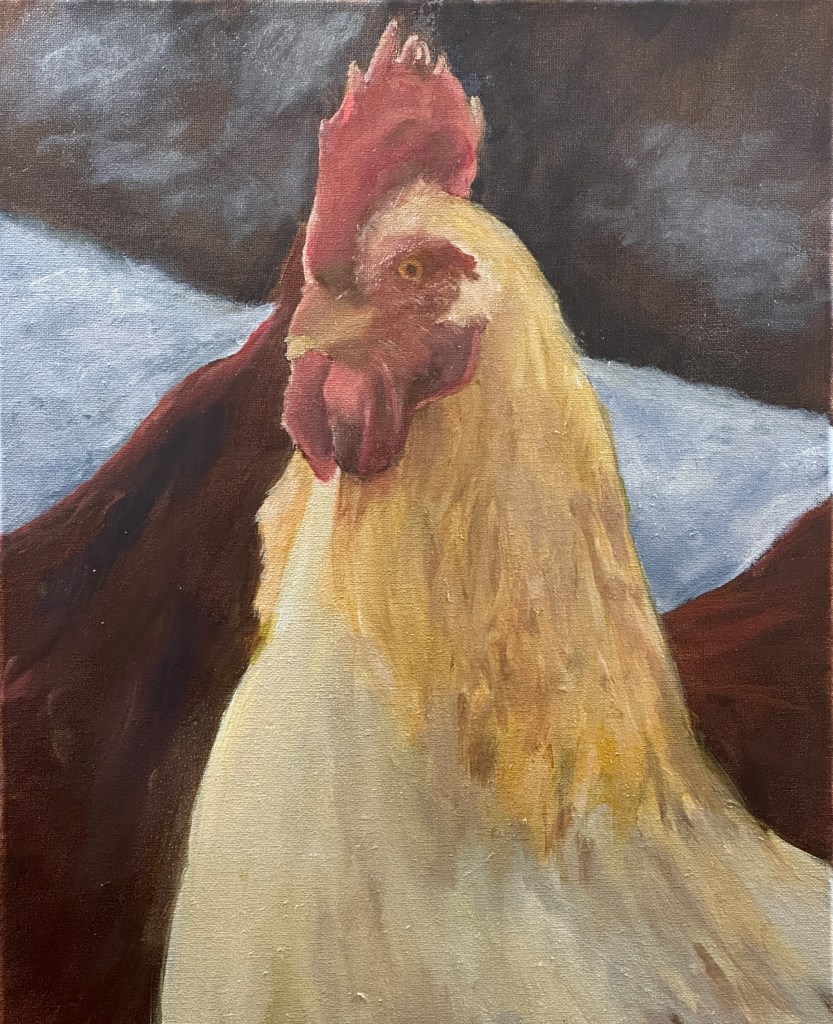
The assignment was to pick from an assortment of bird pictures, and, using glazing, add measuring techniques to paint. After a year of painting into abstraction with reckless abandon, it was quite a pivot but a needed one.
Since I began painting, too often for success is the result of uninformed trial and error. Learning through discovery is invaluable. As a teacher, however, I also know that, without foundational skills, or discovery is often limited or miss directed.
I’ve come to terms with the reality that art will never be a career for me. It will always be a passion and practice, however, and those realities mean it is even more important to me to learn the nuts and bolts, so I started another year-long, art course devoted to learning techniques and becoming a master of my materials.
Discovery is still happening, and learning is learning. When I move back into abstraction, I will have a new set of tools.
A little over 30 years ago I was hanging out at the house of an acquaintance near the densely populated Ohio state university campus in Columbus, Ohio when two armed young men entered the house and told everyone gathered there too surrender our valuables.
Many elements of that evening have faded from my memory. Even right after the crime happened, I still couldn’t tell the police what the guns looked like (They were black). I remember that the criminals were young, but I can’t remember the names of anyone at the Catherine, or even the name of the person whose house I was at.
Sometimes, though, I will hear a a news report on TV on the radio that, for years, could transport me back in time to certain moments of the crime. For a minute, for example, I will relive the few seconds of trying to not look at the face of the boy taking my brand new handbag with my car and house keys and drivers license. I’ll remember trying to think of every trick in every movie about not looking at the face of your assailant, so that they wouldn’t have a reason to kill you. I’ll hear the kid by the door telling us to lie down the floor and wondering if it would be better to be shot in the back or the head (paralyzed or dead) as some other people who had been in an armed robbery in the area a few weeks earlier. And most of all, I will smell and see the beer-soaked variegated mustard and yellow carpet as I wait to find out.
Last night, two stories filtered into the evening. When was the horrific shooting in Lewiston, Maine. I instantly thought of the terror being experienced by the people in and around that bowling alley, as they wondered if they were looking at the last thing they would ever see.
The second story was much closer to home. Reports of gunfire between police and a suspect in the rural town adjacent to ours started appearing on social media in the late afternoon. Then the news reported shelter in place warnings for the town and recommendations for our town to lock doors and windows.
Thirty years ago OSU’s off-campus housing area was a known area for illicit narcotic activity. I couldn’t/wouldn’t even tell my few close friends, because I was too embarrassed to tell them where and how stupid I had been. It was at the wrong place at any time.
I would pay for my bad judgment for years, moving apartments, jobs, and cities constantly to try to find a place that felt safe. I briefly bought a gun to feel safer but, still in a state of constant panic and anxiety, nearly killed my cat one night and decided I was not mentally fit to have a gun. For years, I wouldn’t live in a building that didn’t have a security door or in an apartment on the ground floor.
For a long time, there was a part of me that believed that the anxiety was a product of the guilt of my stupidity. Over the years, as reports of mass shootings have become all too frequent, however, I realized that the anxiety was founded, and fed by the nagging suspicion that at some point, even the most innocuous place is going to have a wrong time.
The people in Lewiston Maine we’re doing nothing wrong last night when they went out with their friends. The people in Salem New York who were being told to shelter in place, didn’t deserve to lose their sense of safety or well-being.
For me, it is no small irony that we are listening to updates, and feeling more secure, in a hotel in Boston with a strong security system than we would have in our own home. But the security system is not the only thing that is keeping me from spiraling backwards this morning.
I have an antidote.
Last night we brought our son to the city to begin peeping at colleges. We took him to to see a band that has influenced his music and, for some reason standing in the music hall, surrounded by people, enjoying young people making art help quality anxiety for a short time. I had to leave because my Ménière’s disease won’t let me experience light shows the same way anymore. For the ride home, however, the knowledge that there were young people dedicating themselves to creating something that brings people together was therapeutic.
It helped me remember that at least some of the answers are in leaning in when the conversations get hard. They’re in reaching out to kids who are struggling and kindling creative sparks. And, for me, they are the antidote.
I have a well-known diet Coke addiction that serves no other purpose, except to introduce as much caffeine to my system on a hot day as possible. I have another addiction – art supplies- that’s possibly almost expensive as the diet soda, but, unlike any other habit, this one with a higher purpose – the belief that I can make something out of that.
The ability to see an object for its possibilities and not just its current state may be the driver of every single art supply purchase in the world, but it is also a serendipitous gift of insight that cannot be denied. At least, that’s what I told my husband when I came home with a nondescript, open paper bag full of paints, canvases, and brushes last night.
So what excuse do you give your significant other?
For the better part of the last few decades, phonics has often been taught using an analytical approach — embedding phonics instruction into broader reading lessons with varying degrees of explicit instruction, depending on the school. Research has shown, however, that a synthetic approach – – putting explicit instruction in phonics in the center of early reading-is most advantageous for the majority of children.
I have been taking the synthetic approach to my creativity for a decade now. I exclusively set aside time to write, draw, or paint when I can. The only downside to that approach is that it fails to recognize places in which creativity is embedded in the rest of my life, and, the days that I miss the explicit, “synthetic” practice, I tend to let the day get crowded with shoulda, coulda, woulda’s and other guilt that comes from failing to meet a daily agenda.
The reality is that, for most of us, creativity is embedded in our daily lives. The synthetic practice is not unimportant, but it is not a requirement for living a creative life. Recognizing those moments of creativity — taking the analytical approach to embracing your creativity – takes its own sort of practice, however.
There is science in the teaching of reading. Perhaps there has to be because reading is not a natural act. It is something that humans invented.
Creating, however, is what makes us human. It is the most natural of activities for our species. We create to solve problems. We use things in inventive ways to entertain ourselves.
What we often failed to do, however, it is to recognize and nurture that embedded creativity.
I still am committed to making time for explicit acts of creativity, but my mission, as I start the busiest season of the year, is it to engage in daily acts of analytical creativity by being mindful of the moments when it embeds a little magic into the mundane that is daily life.
Saturday morning I came across a Facebook post by a musician friend describing the “unifying breath” taken by a choir or orchestra before they begin to make something beautiful that brings them and their listeners together. It was still in my head later in the morning as Thing2 and I were driving to Home Depot and talking about his college plans.
Thing2 plays guitar for several hours each day. He’s been playing with that intensity for a few years now, and that intensity seems to be leading him to audition for one music program or another.
Thing2 has other interests — often a sounding board for friends, he has thought about going into mental health counseling or psychiatry – but, as we talked, I sensed that something other than passion for the subject was driving this recent career exploration.
Thing2 also has an older brother who found a more traditional field (computer science) and is now earning more money than both his parents put together. Thing1 loves his new life, but he also loves the work of problem-solving. He has found his passion.
“I like the idea of helping people,” Thing2 said.
I reminded him that when musicians bring people together to enjoy music, they are creating moment of communal peace that no other art or craft can achieve. Painters can’t do it. Writers don’t do it. Doctors and teachers don’t do it. Yet, even in our small town, a kids’ concert or an impromptu band can bring together people with wildly different experiences and viewpoints for the sole purpose of enjoying music together.
“I know,” he said. He started to say something and then was silent for a bit. We talked about music education and music therapy as career paths. Then he said, “When I listen to my favorite musician, I think about being able to make something that so many people will enjoy, but…”
We walked through the lumber aisle, and he said again how great it would be to have people responding to his music the way he responds to others. I reminded him of one cousin who is making their life in music and another is making his career in music and music production.
“I’m just afraid,” he said. “What if I put all my energy into a dream that is really unlikely and then find I’m in my thirties wishing I had done something else?”
“Creativity takes courage,” I blurted out, knowing that, in recent weeks, I had been ignoring the words of Henri Matisse, retreating to realism out of fear that people who have bought my art in the past won’t like my abstract work. I knew my response was trite.
I could have told Thing2 about coworkers who started with creative careers that took them in unpredictable directions and different fields where their creative natures and backgrounds were integral to the successes.
At that moment, however, I wanted more than anything for him to to understand, at the age of 17, the big and improbable dreams are just as important as the practical ones. He needed to understand the value of his art in his life and the difference it could make in others’. He needed, especially as adult life gets closer, to be willing to take that leap of faith in himself.
We were still talking as we sat in the drive thru waiting for a coffee order.
“I won’t give up on abstract if you don’t give up on your music,” I said.
“Okay,” he said as he extracted a promise to have first pick on paintings he likes.
We shook on it, and I gave him a music writing assignment inspired by my painting teacher.
Our new bargain is way more better deal that others I’ve made with them over the last few months (a Faustian bargain to give up my favorite diet soda, for example). It’s also the most important deal I’ve ever made with him.
It reminded me of the first rule of teaching, which is that we teach what we model, sometimes, without even knowing it. And now at this crucial time in this wonderful kids life, it’s more important than ever that I start to practice what he needs me to teach.
With one of my kids, recently grown and flown (Thing1), and the other, starting to contemplate his life outside the nest (Thing2), I find myself thinking more about what might have been if I made different choices.
I used to wish I had made different choices — better choices.
I am not naïve enough to think of my life is anything other than a journey filled with missteps, redirections, and spectacular mistakes of my own making. Some of those mistakes were due to circumstances I couldn’t control for a long time, but others were simply bad choices.
When I was Thing2’s age and going for college visits, I desperately wanted to go to art school. I let a tough but fair portfolio critique and well-meaning but off-target input from my parents derail further attempts for art school or even a fine art major at a college.
Even now, however, a conversation with one of the art professors at the school I did briefly attend for another major rings in my head. “You should do this only if you need to paint,“ he said. I needed to paint then and still do.
If I had been stronger or braver, I would have done more of the type of drawing that would’ve led to getting into those schools. If I had been more sure of myself, and willing to confront my bipolar disorder, (or even realize what it was) I had a younger age, I might have stood my ground and picked the fine art major.
But even as I think about those mistakes, I don’t have regrets. Those mistakes inform the advice I give my kids.
My mistakes eventually brought me back to art. They brought me to teaching, which is one of the most fulfilling experiences of my life even as it is shaped by, and then informed by creativity. Mistakes they brought me to these conversations with my chicks as they are leaving the nest.
Without my mistakes, I wouldn’t have the big guy I married. I wouldn’t have an adult child, who comes home to geek out with me over the latest happenings in Tech. I wouldn’t have a soulful, introspective Thing2 who is a sounding board for his friends, and art critic at large.
It makes me realize that the best advice I can give to my kids is to start making their mistakes as they find and live their truths.
Monday, less than a week after I got my studio back and functioning, I put on my student hat again as my fall courses started. Tonight, I am putting on my teacher hat to get ready for the in-service days that precede the arrival of middle schoolers into our building. They fit over my flamboyant, feathery artist hat (which sits over a tightly-fitted tinfoil hat that I wear for my mom job), and, as I do with the beginning of every school year or text season in the past, I wonder what will happen to my feathers over the next few months.
Part of getting my studio back was an effort to keep momentum of a year-long painting mentorship. The other part was to create a tangible space in my life for creativity.
I know that the feathers on my artist hat are long and flexible. They will find their way through the cracks between my teacher and student hats. Even the most tenacious tendrils, however, need air and fluffing on a regular basis. This year – the busiest year yet -makes it even more important to strike a balance between carving out time dedicated to unscripted inspiration and simply integrating it into the other parts of my life.
Integrating creativity into daily life is vital. It alters your perspective about learning and living. Sometimes that perspective simply helps you find the magic in the mundane and opportunities instead of problems.
Fusing creative approaches into daily life, however, doesn’t take the place of keeping a sacred space for creating for its own sake. For me, honing in on painting or drawing or writing — making for the sake of making – is about refining skills, but it’s about something more. It is about meditating on and then escaping from the worries of the day. It is about nurturing something divine that lives in each of us.
Finding the balance between fusing creativity into the everyday and dedicating time and space to making is the foundation of creating and re-creating oneself in to keep up with the job of being fully human. It means finding a way to make all the hats fit and still let the feathers breathe.
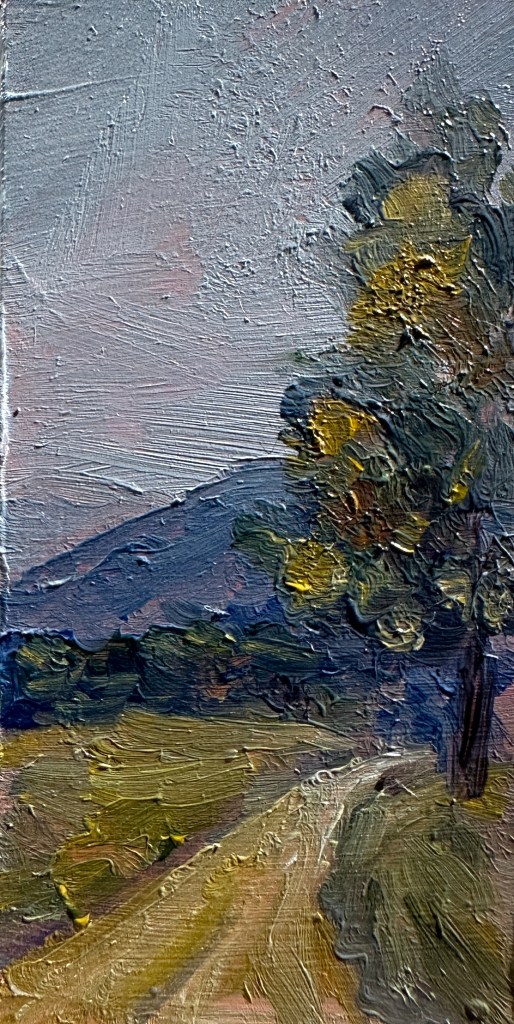
This was the second of a pair of paintings that upended my outlook on landscapes.
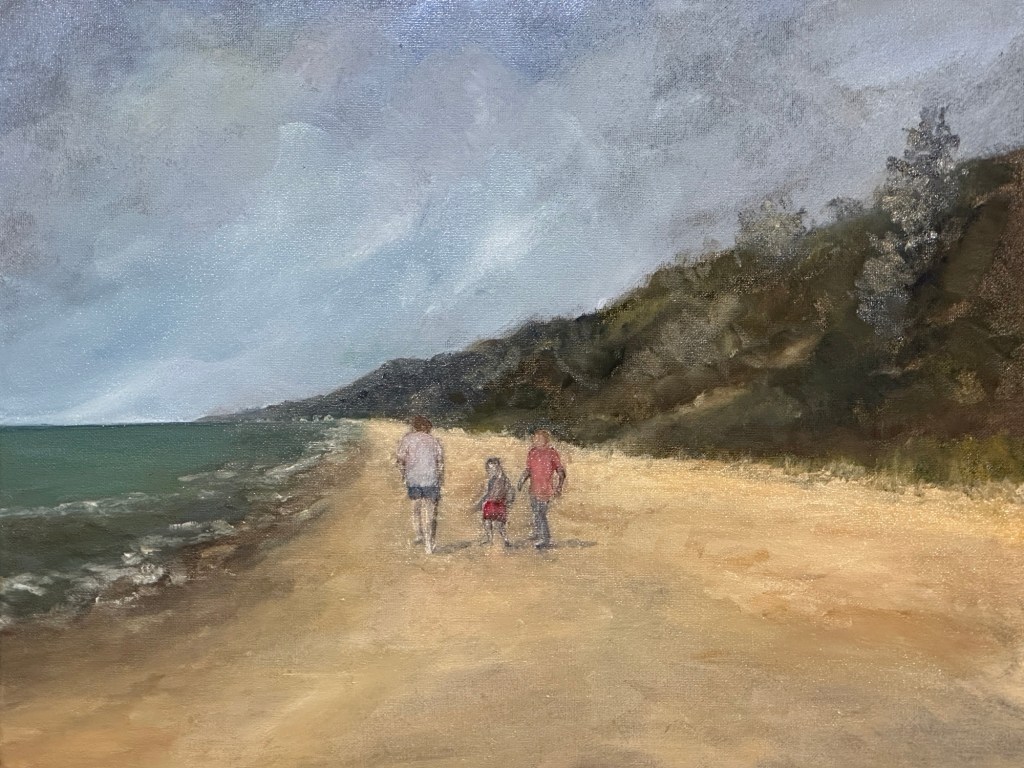
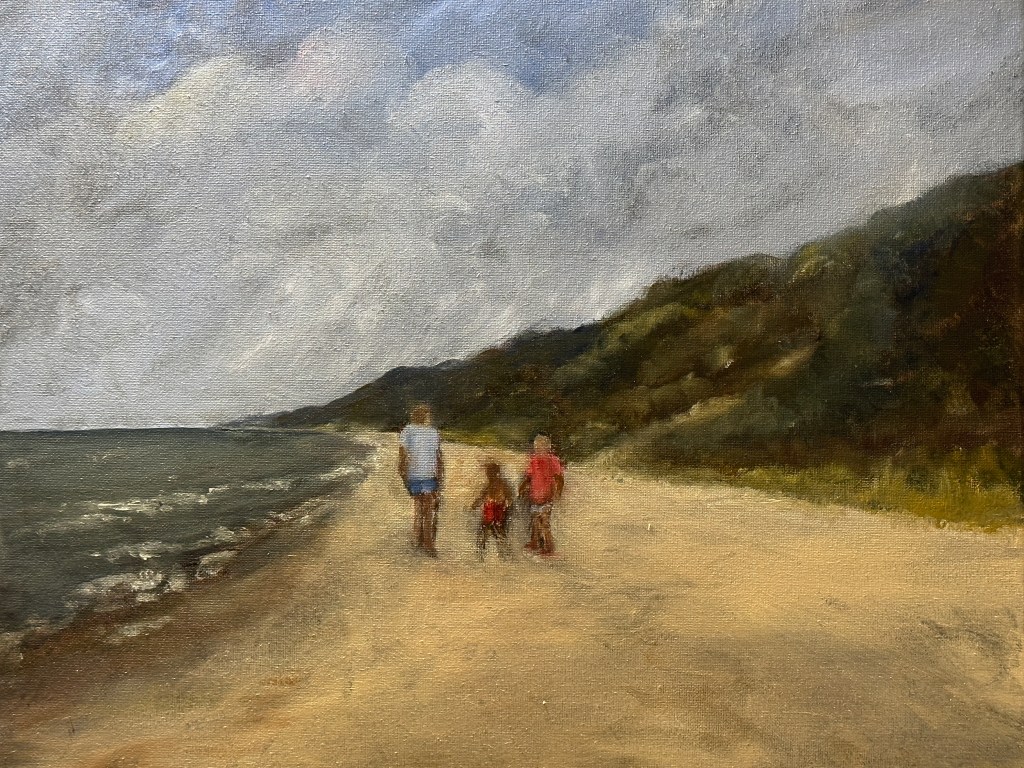
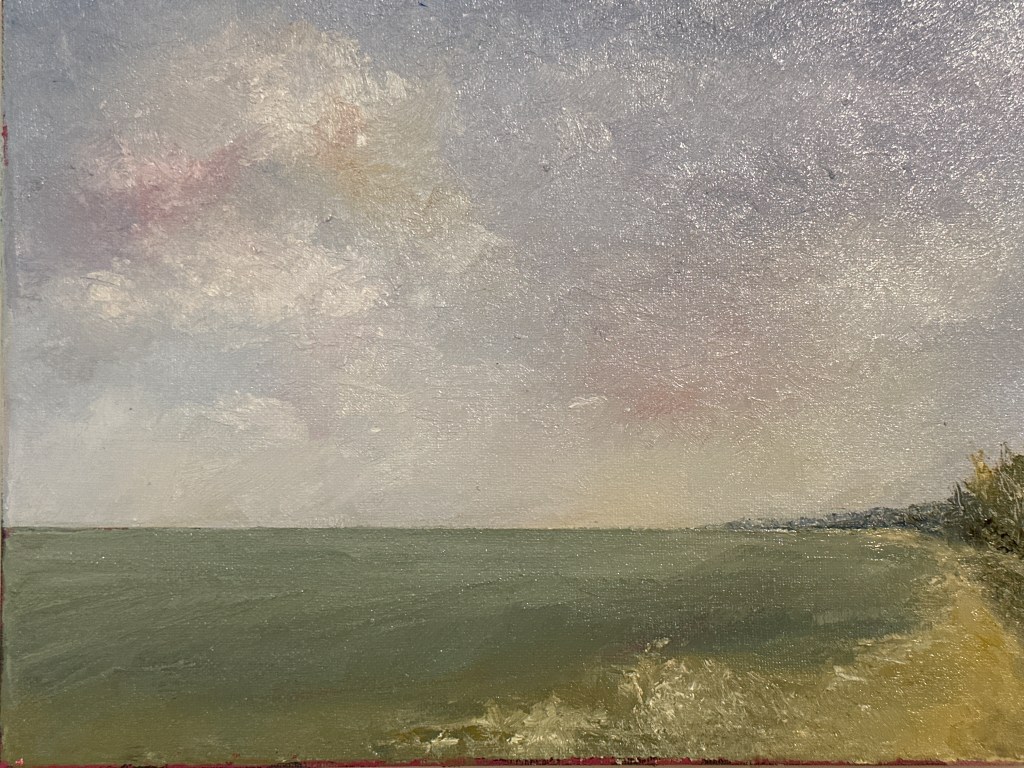
For the past few years I’ve been painting the scenes in Southwestern Vermont and Michigan, and it wasn’t until a conversation with my mentor that I realized that all of those stories featured ensemble casts. Most of my pieces feature the mountains or lake and sky and any elements that add to the drama of a storm or setting sun.
Painting in a small space with rain misting over me for much of the weekend, however, meant that the compelling element in a piece was a cast of one. I started filtering out the noise in the scene and in my head and focused on what mattered.
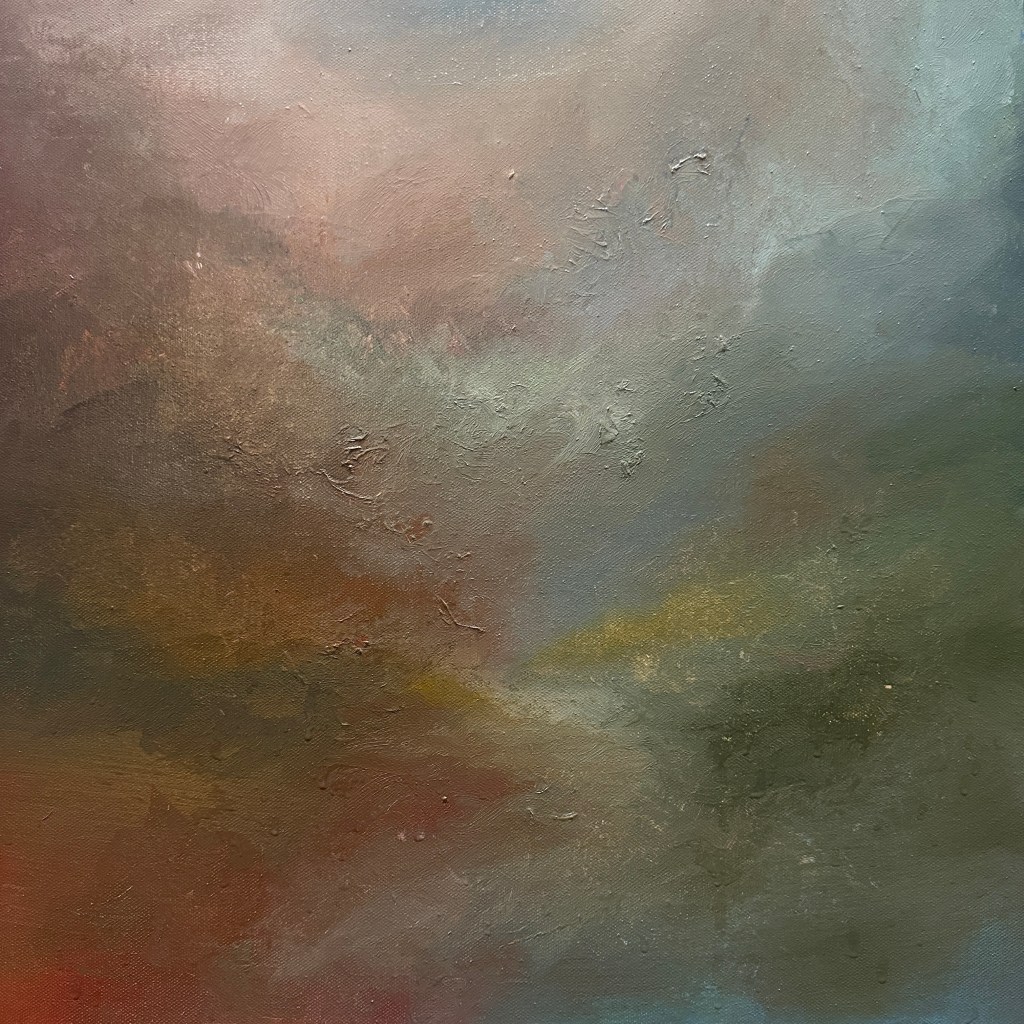
The last week or so, I’ve been in my studio painting what pops into my head, and the ensemble cast has made a return.
This piece and the one below, however, hang on the wall beyond my easel as to remind me to get out of my head and connect with life and to be compelled.
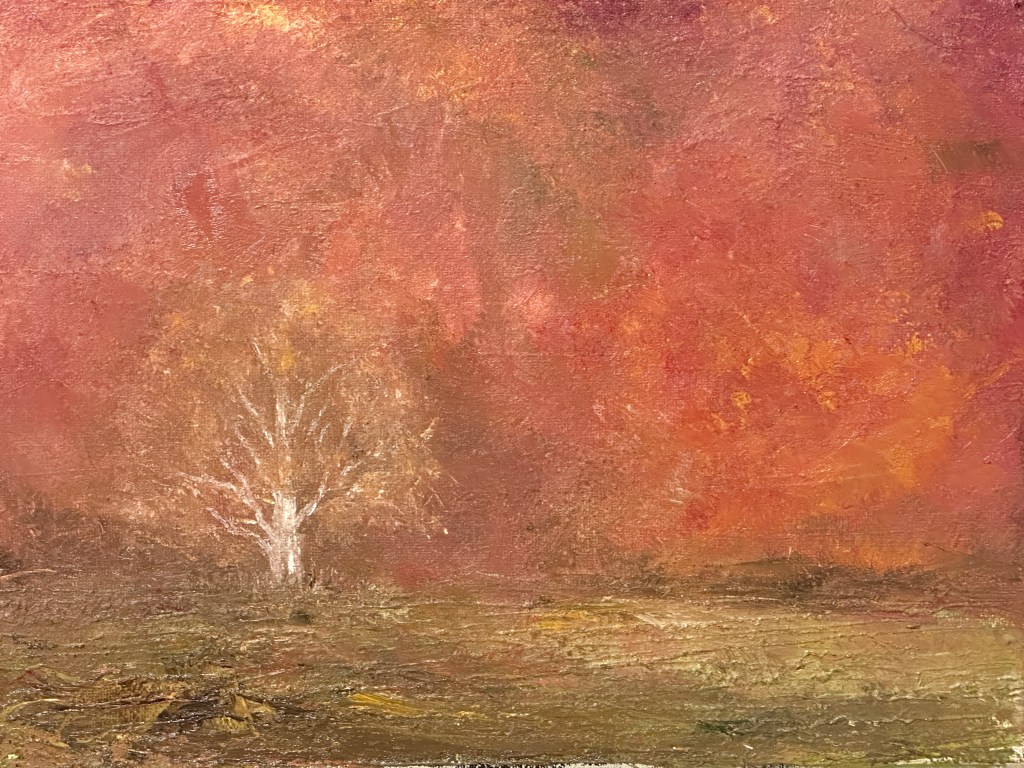
The punches of color are showing up more frequently along the southern Vermont roadsides, and this painting started as an attempt to keep the glory of late summer early fall in my head.
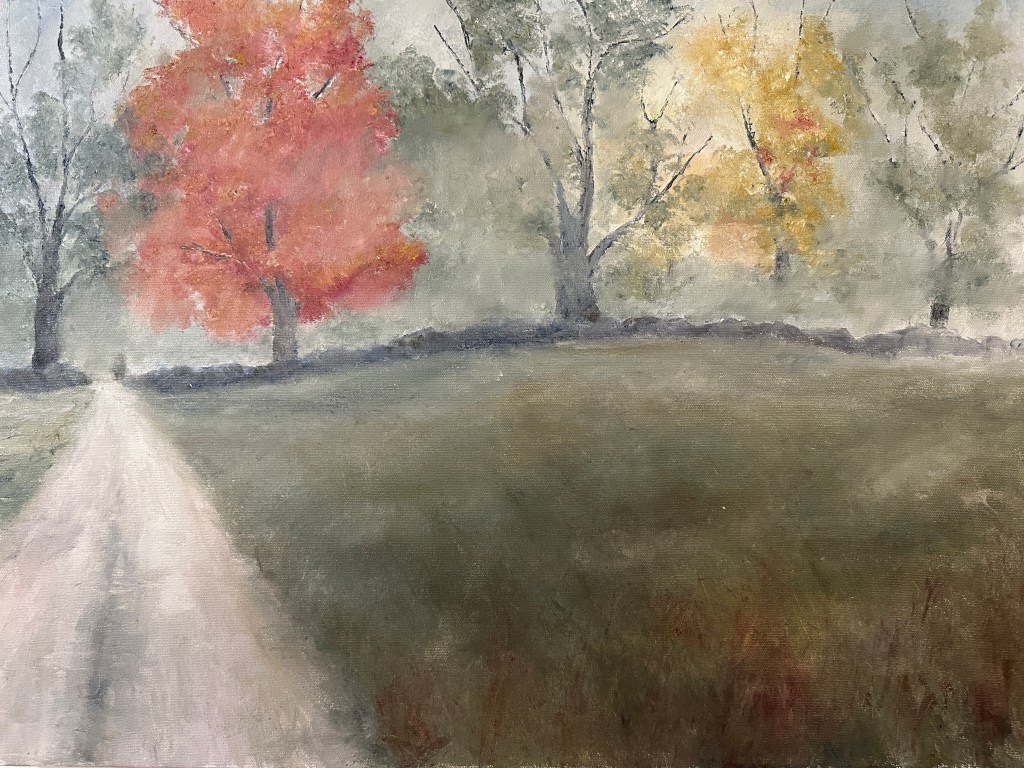
Instead, on this last weekend, before school and graduate work, begin again, I found myself returning to memories of, soggier fall days. At first, I thought this rainy summer was living rent free in my head, but, I realized the fog had its origins and anxiety about the ability to meet the demands of the coming square and to continue to paint without a mentor and outside schedule defined by work and study.
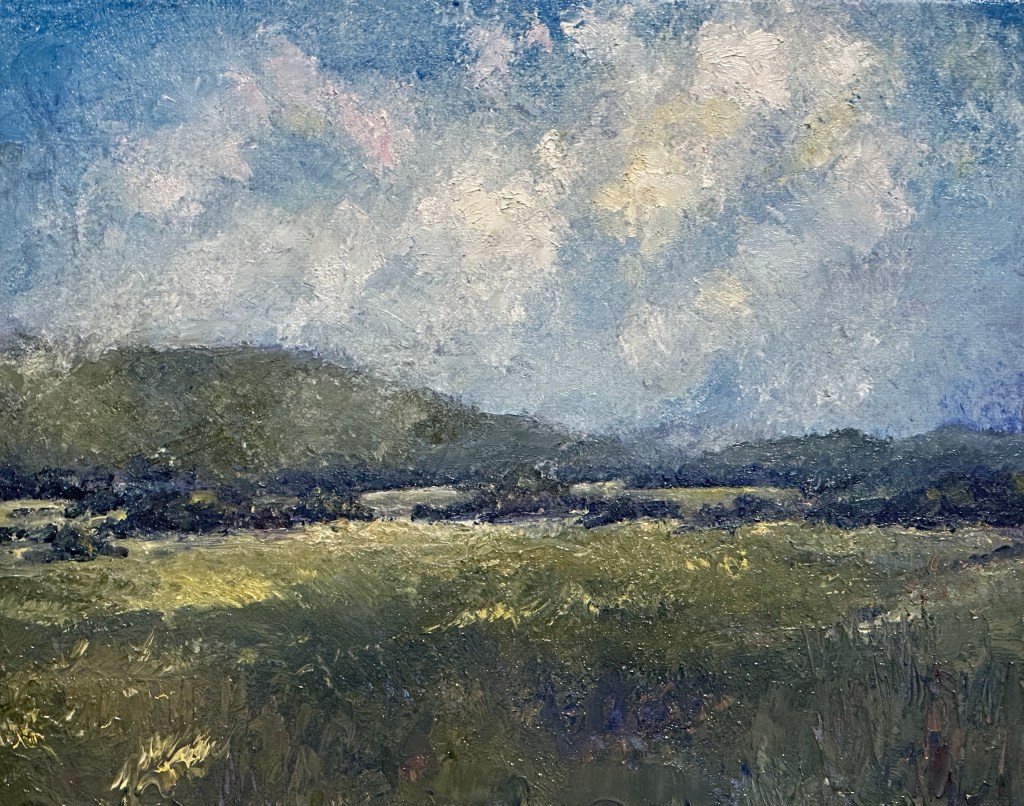
The last few lazy days of summer, and right now, it’s the light and the lines of the trees that compel. There are some red hair in there, but mostly the mountains are a jumble of green and gold.