Too Soon

Please contact me if you would like this painting to live on your wall.

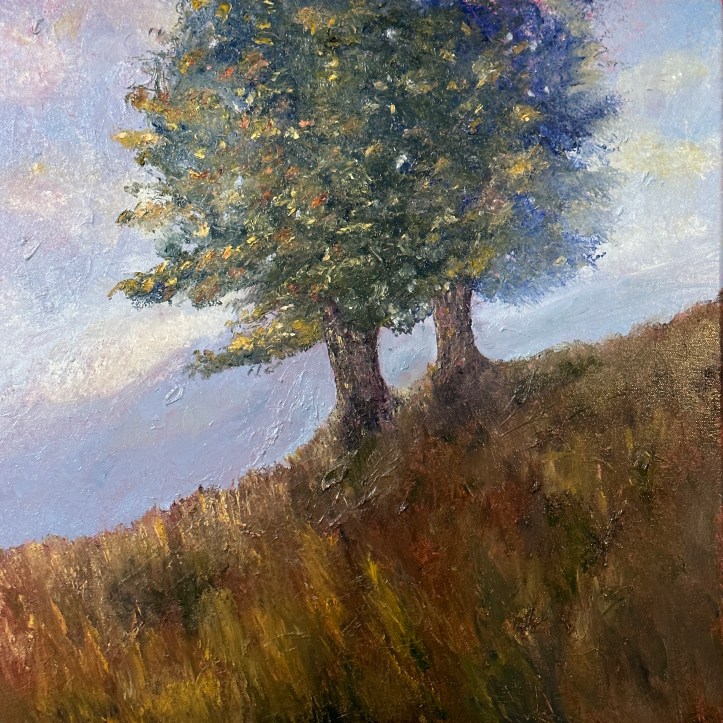
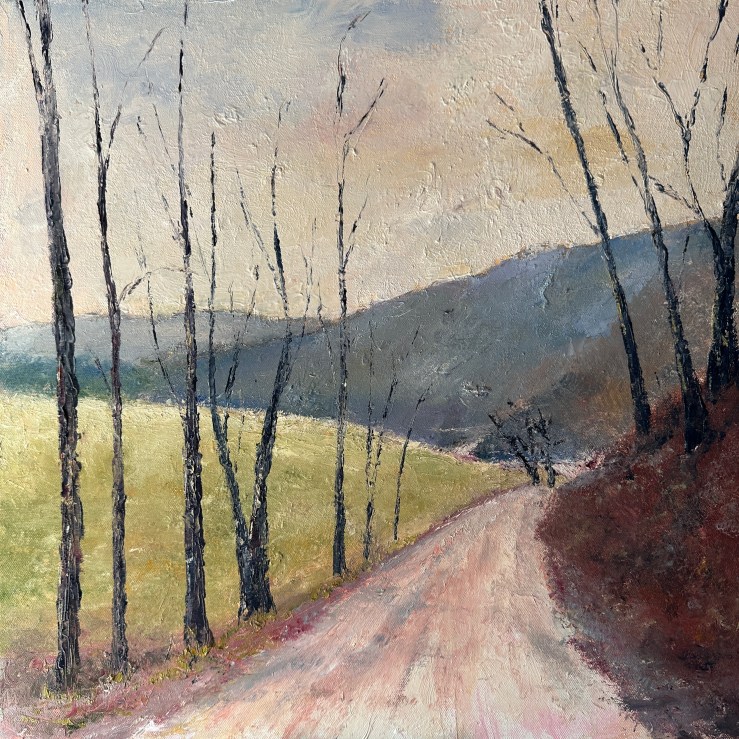
Too much rain has brought out the fall colors far too soon. They are just starting to peek through, and it would only have been noticed on a day like today when the sun makes an all too rare appearance for the summer.

The first spots of red and orange always seem to be signs telling us to enjoy time outside and carefree days while we can.

Hill Climb

Please contact me if you would like this painting to live on your wall.

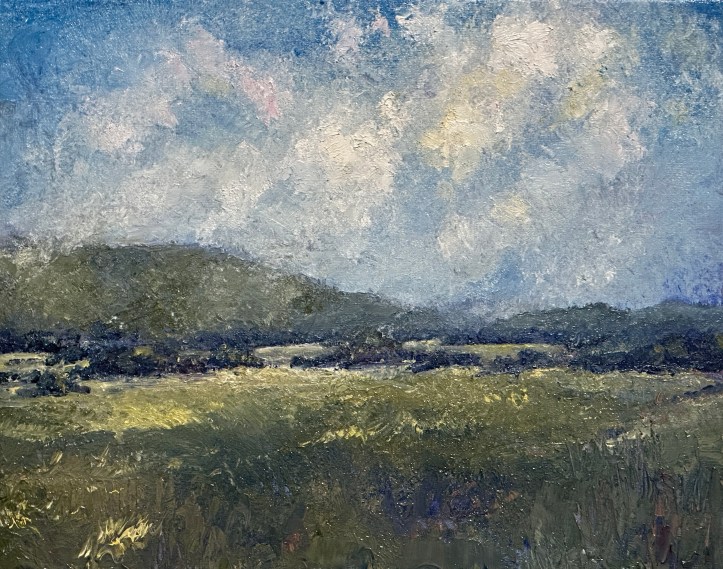
This past weekend Manchester/Sunderland, hosted the annual hill climb — a bottom to top tour of the Equinox mountain in Manchester, Vermont. The hitch is that all of the cars doing the climbing are classics, and none of them are equipped with the all wheel drive that is emblematic of most vehicles in our brave little state.

I passed by the classic car convention a few times this weekend, every once in a while, wishing we could take an hour or two to drive to the top (Thing1 climbed it by himself on foot on his 17th birthday). It was a perfect day to be at the top of a 5000+ foot mountain. Puffy, clouds, and the sky is a deep saturated blue these days.

Missing Michigan

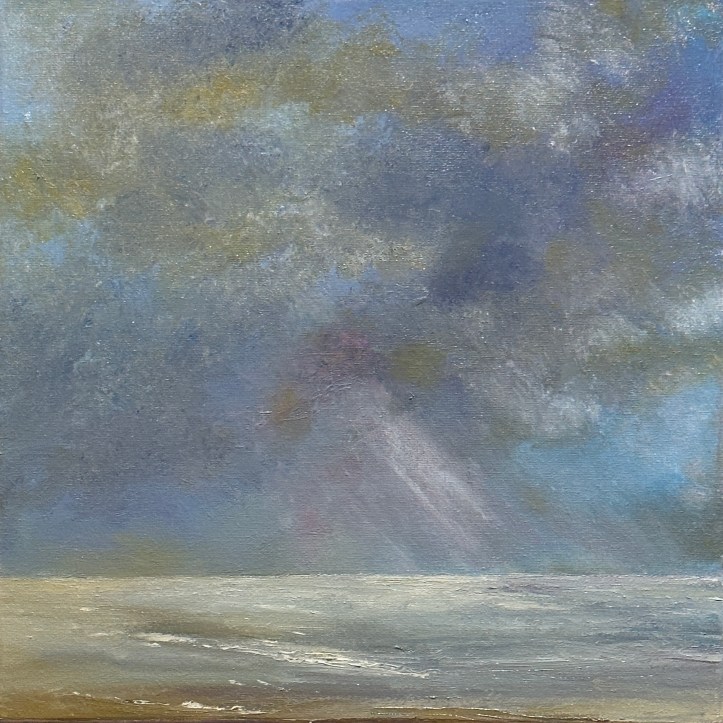
Too many things came up this summer, and we are missing seeing our family along the banks of Lake Michigan. I anticipated missing seeing parents and siblings, but I’m always surprised when I actually miss the violent storms that are a fact of life up there these days.

Increasingly, south western Michigan sees storms coming off the lake that morph into tornadoes. It’s always scary when it happens or is being reported, but it’s also more than a little exciting.

I don’t wish for death the way I did when I was younger. I even fear it a little now, and when the storms come, sometimes threatening life and property and getting hearts pounding with the wind, they are powerful reminders of just how alive we actually are.

Art in Layers

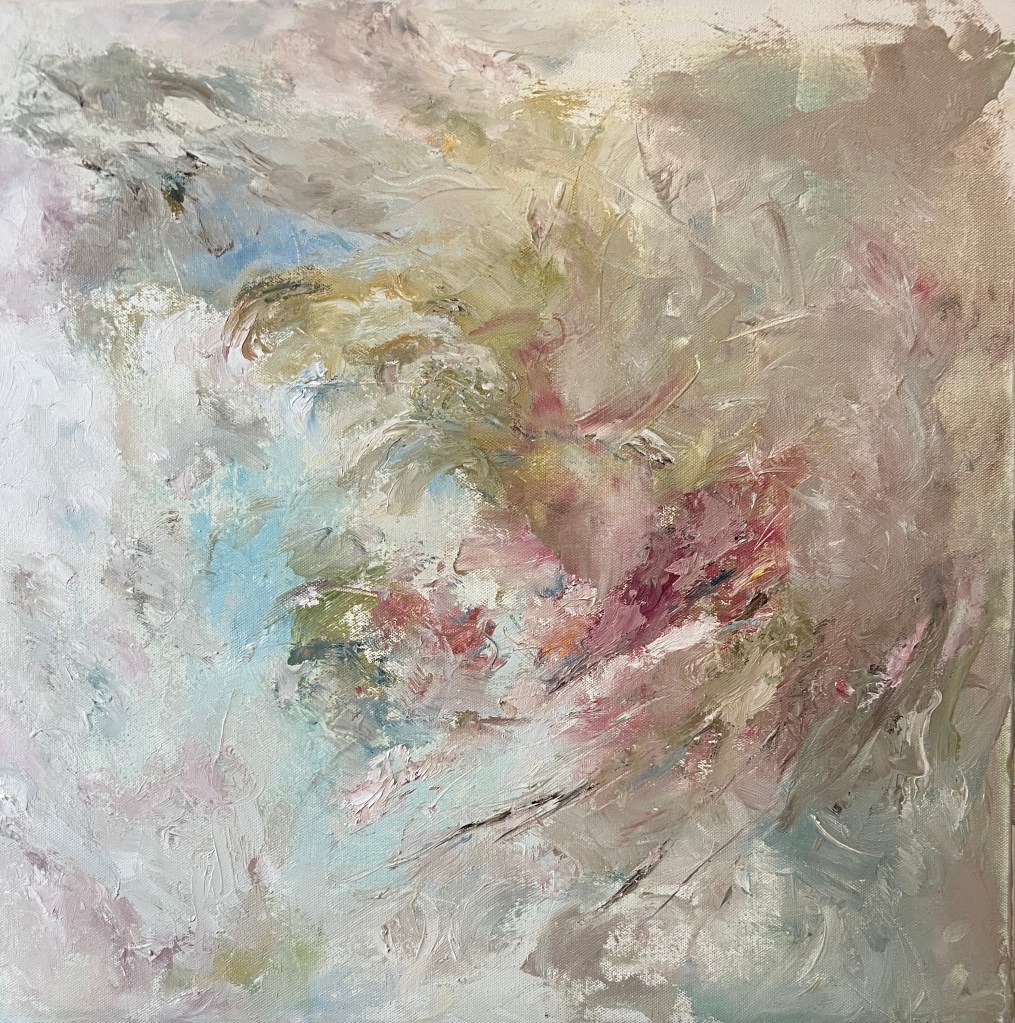
I’ve noticed a trend as, trying to find my voice and my style, I’ve painted with a mentor over this last year. The paintings that have been the most satisfying still seem to occur by accident. There’s more intention in the way that I work each day – starting with reckless abandon, trying to find the joy, then looking for the element in the moment that compels me. Very often, however, the paintings I like the best of the ones that emerge through layers of missteps and experiments. The final piece is scarred with evidence of prior experiments and discoveries poking through.

The realization came to me while we were in Rome at the beginning of July. My husband and I, both keenly aware of that Thing1’s impending move to the big city signaled that opportunities for family vacations are dwindling and booked a trip for the four of us. I got off the plane hoping for days of watercolor sketching, but, wandering a city filled with sights that compel you, I struggled to hone in on one thing. 

As we wandered from Imperial ruins to medieval neighborhoods and collections of renaissance art, however, the intense blue of the sky brought the colored stucco into sharp relief. At first I thought the pinks and yellows and oranges were the compelling elements, but, as I sketched the doorway of our apartment, noticing the layers of history between the wall and the cornices, I realized how Rome had cast such a powerful spell. 

It was the same reason that authors written about — the city is always changing and evolving, but the scars of history are never completely erased. A fresh coat of stucco doesn’t completely hide cracks from the layers below or the stonework that forms the original structure of a wall. Medieval timbers may form the ceiling of an apartment with 200 year old windows and conduits for ethernet or electrical cables. 

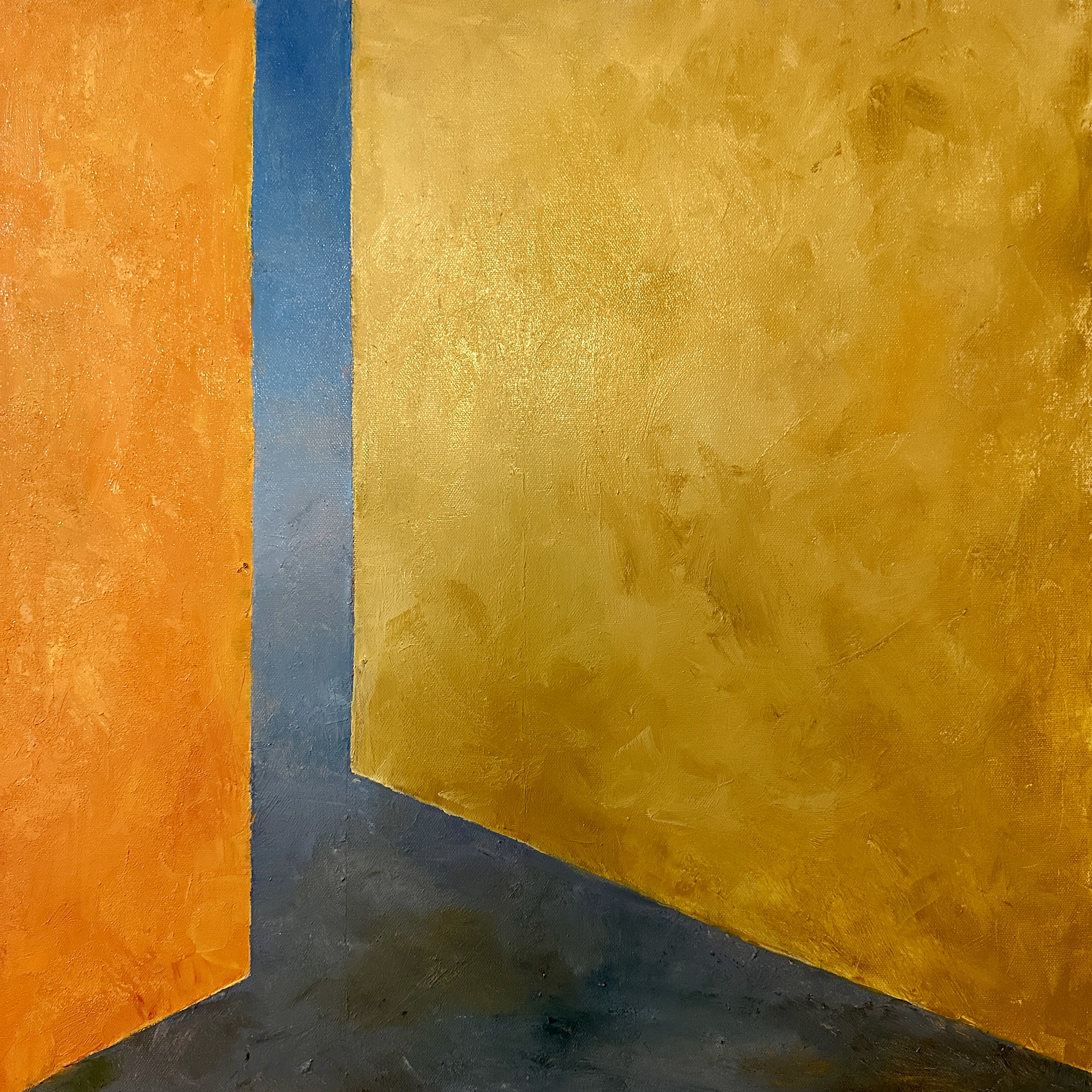
The city exists in layers, and that is what I ended up painting when we got home.  I had been painting it for months without realizing it, and painting those scars and reminders of all my mistakes and little victories has turned out to be the the best expression of who I am as an artist — and a person.

Walking to First

It’s the end of day 7.

This time last week I was voluntarily getting hit by the chemical equivalent of a baseball bat to the inner ear and brain to try and get some of my old life back, and, after a day or two of delayed side effects, did what any batter who gets hit would do. I took the walk.

Now, at the end of day 7, I’m slowly crawling to first base. The fog is starting to clear bit by bit.

I’m heading back to work tomorrow, regardless of the wisdom of that idea. I’ll be sitting on first, waiting for the signal to start running again, but, after the cathartic weekend of painting that preceded the bat to the ear, I know exactly how it will feel.

It won’t be a feverish productivity or blur of activity. It will be when the need to pick up the brush cuts through the spinning fog. It won’t feel like guilt for having neglected work or art. It will feel like a lifeline pulling me in.

What Compels You?

At the Point, 14″ x 14″, Oil on Canvas
Click Here if you would like this painting to live on your wall.

I tried to paint a different spot in that creek the night before, with no success. I knew instantly why it hadn’t worked. I was trying to paint everything all at once, and everything at all at once doesn’t work in any part of my life.

Saturday had been an incredible day of painting in the Pennsylvania countryside with my mentor. Work and an upcoming ear procedure had receded to become a blurry part of another background. I had meditated with the trees and the past their prime daffodils as the clouds chased the sun, and an occasional mist called me off.

Saturday had been a success, because I had stopped to meditate on the trees, intertwining with each other, and taking the time to answer the question, “what compels you?” What part of this part of the natural world compels you to simply stand and exist in the moment, without making plans or replaying conversations where you wish you had said some thing else?

What compels you to just let go?

That was the question.

Sunday morning I struggled to find that focus. The upcoming procedure was closer, and that evening reality would creep in with homework and budgets.

Now, my mentor and I stood on the rocky shore of the creek, watching a group of horseback riders waiting for their mounts to drink and splash. It was a magical moment teeming with characters and details.

I turned away from the charming story playing out in the creek, and something that looked like a heron standing on a jagged shore further down caught my eye. The rocks around him gleamed in the sunlight, and the water quietly eddied around the larger stones that fortified his peninsula. My mentor and I stared in its direction for a while, a different element, capturing each of us.

“I don’t think that’s a heron,“ she said.

I tried to zoom in with my camera, but it was no more accurate than my eyes. For a minute I thought of that scene in Harold and Maude, when Maude insisted that a remembered, flock of seagulls would always be glorious birds to her. I decided that even if that glimmer of light on the shore was a carefully hung T-shirt, or a spiky stump, I would let it remain a glorious bird that had first drawn my eye to a sliver of sunlight in the middle of the river and got ready to paint.

I knew what compelled me about that scene, and it wasn’t the possibility of a glorious bird. It was bright clarity of simplicity emerging from the murkiness of “everything all at once.”
The Not So Bad

Most of the time I hate Ménière’s disease. When you’re not being violently rocked as you try to get to sleep at night, you are hugging the floor trying to get the world to stop looking like a ceiling fan that gets stuck on a quarter turn, and then resets itself before Turning again. There are perverse times, however, like right now, When the salts and crystals in my inner ear, create the sensation of being on a an inflatable raft on Lake Michigan on a gentle wave kind of day.

In two weeks. I’m going into the hospital to have a procedure that will probably cost a good amount of hearing in the affected ear in exchange for getting my life back. The trade is going to make it easier to drive and work with some stability. Even though I won’t miss the vertigo and the falls, I’m trying to commit tonight’s gentle wave sensation to memory. It’s a lesson that even the things that make life really hard sometimes, can bring an unexpected smile to your face.

Back to the Land

An interrupted meditation by the Battenkill

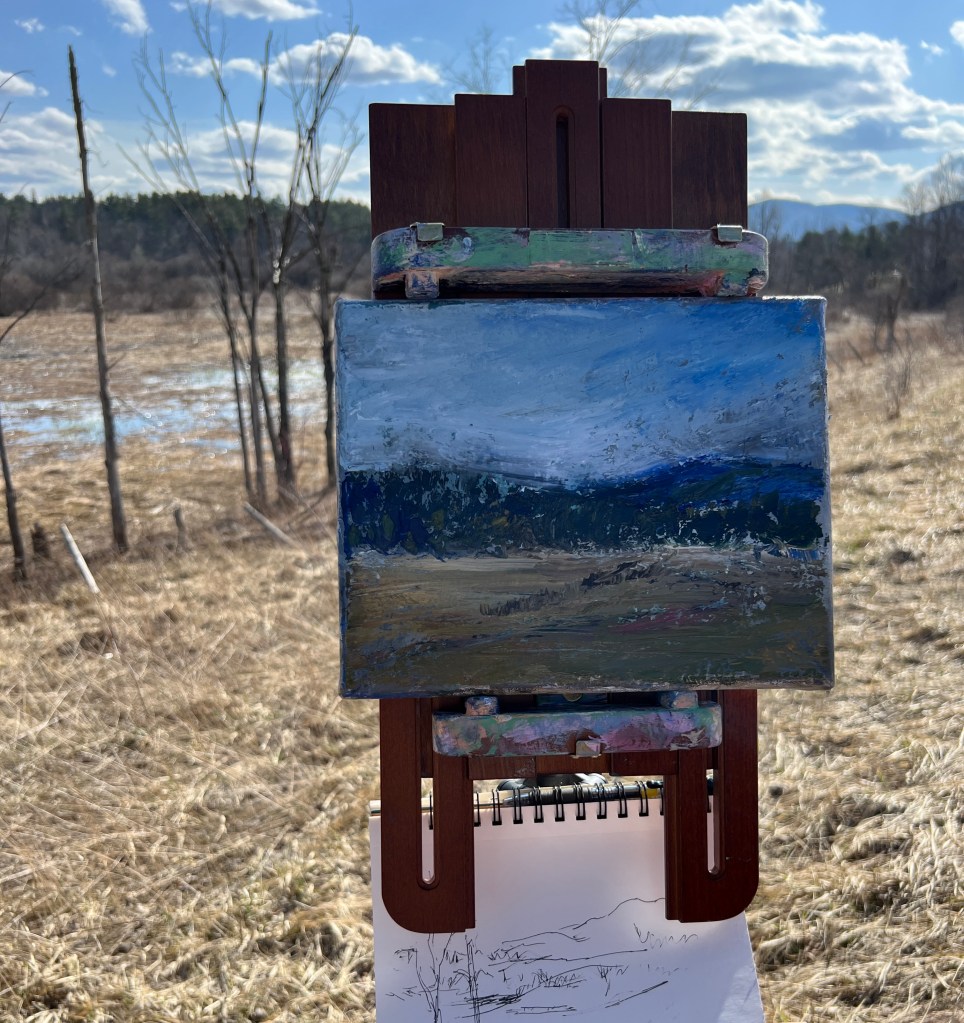
I’m having a lot of conversations with spring in my work these days. Some days spring is popping; others it’s buried under a fresh dumping of snow. Likewise, some days I paint the conversation with reckless abandon and no image in mind, but as my head turns, outdoors again, I find myself going back to the land to absorb and paint it as I feel it in the moment.

The natural world feeds my soul.

A few months ago, I worried that returning to representational landscapes was simply a fear of being brave enough to paint abstract. Now I realize that the mountains and changing seasons are not only integral to feeding my soul, they breathe new life into creativity.

Going back to the land doesn’t become a choice between abstraction and reality. It is the way to connect the visible world to the abstraction that lives in the soul.

Talking to Spring

Talking to Spring, 20″ x 20″, Oil on Canvas
Click Here if you would like this painting to live on your wall.

It’s been in the 40s and 50s the last couple of days, and even though there are some sizable snowbanks left, it feels like Mother Nature is ready to keep her annual promise.

The light is changing. it lasts longer every day. It seems as if there are even more critters crawling around in the dark outside. 

Suddenly, the forest that seemed populated only by the wind a few weeks ago, is teaming with life again.

How Do You Do?

Once upon a time I saw myself as (primarily) a writer, and I did my morning pages every day for work without fail.

Nowadays my job starts earlier, and there is no time for morning pages or sketches. Sometimes that disconnects me from art like a bird not flying for a day, and then two, and then ten.

I know if you’re reading this blog, you’re probably a creator too, so my question to the zeitgeist on this rainy afternoon is, when do you make your morning pages happen?

Spring Cleaning

Clearing

I’d read the same paragraph about neuroplasticity three times and been unable to remember what the major point when I made the decision to kill off a part of myself. I did it with a tiny little pill. It will be a drawn out death, but it’s not a murder. It’s self-defense.

For as long as I can remember, a highly structured, complex fantasy world has occupied a good portion of my brain. Psychiatry journals tell me I use it to cope with anxiety and PTSD that I should be old and experienced enough to manage without a tiny little pill. But, as I annotated another article on the miracles and vulnerabilities of the human brain, I realized that by letting my cranial amusement park stay open, I’m a hypocrite.

My still embryonic career as a special educator has focused on children with intensive needs, specifically children with behavioral and mental health issues. I’ve been where many of them are. They’re my tribe. But the most important part of my job is to helping them be present in the world — something I’ve lacked the courage to do consistently. To be present for them, I know I have to be present for myself.

I’ve had the the pills (and several other similar prescriptions) in my pill drawer for a few weeks now. I’ve told myself I’m holding off to make sure the side effects don’t get in the way of work, but, after reading a paragraph three times because I keep returning to the fantasy world, I realized things are already getting in the way of the first truly meaningful professional experiences of my life. The fantasy world even gets in the way of making art.

There are things that get in the way of work and life that you can’t control like a chronic illness. I’m starting to accept mine, albeit ungracefully. But there are the things that you can control, and all of that control starts with being honest with yourself. Honest that mania and depression do not improve your creativity; they keep you from picking up the brush. They are not the inevitable byproduct of discovering a very real disability; they are the excuse to wallow in the fantasy world.

Killing that world is scary. It means cutting off and escape from reality. It’s even scarier than admitting that, in your fifties, you have the fantasy world in the first place. But, today, the realization that it, and not any disability, could keep me from doing the things I desperately want to do, meant that it, like a tumor, had to be irradiated.

Conscious Detachment

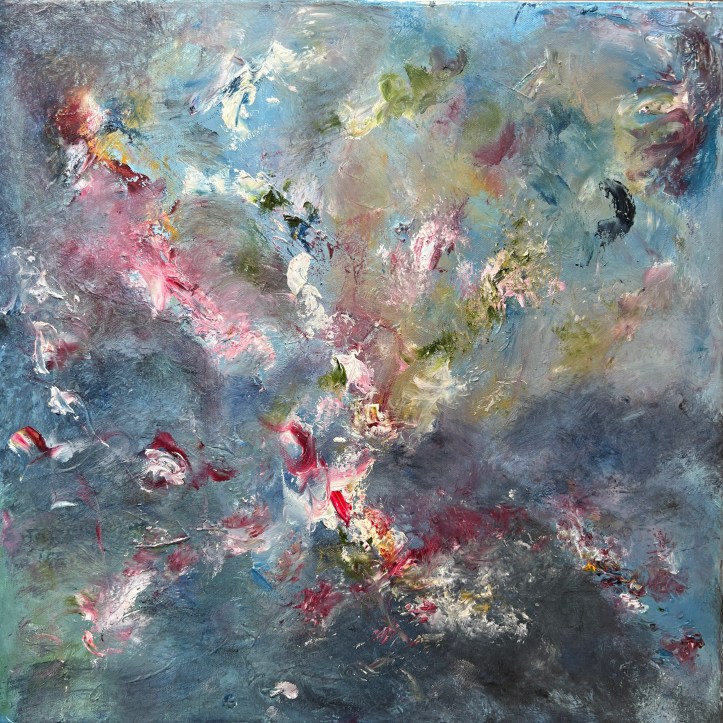
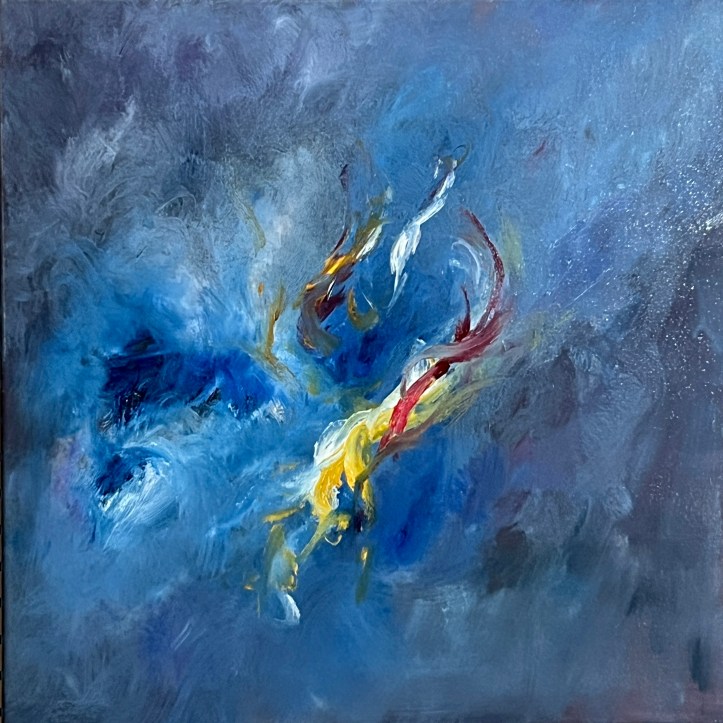
I’m doing a very different set of paintings right now. Winter seems to be losing its grip, the light is glorious as the angle of the sun shifts, but I am still stuck in my inner world. It’s the one I find myself painting recently because, for the first time ever, I have found the perfect medium for it.

My inner world could only be called abstract. The stories in my head could only be sketched as  chaos — documented fodder for a future commitment hearing. Giving into that world when I am in front of an easel, however, casts new light on the value of retreating from the world.

Everyday I work to help kids who are not neurotypical manage stereotypical behaviors that are barriers to educational and social development — not always but still too often because of a world that fears any behavior that isn’t “normal”. As a special educator and a doctoral student studying behavior, I understand the importance of helping children interact with their surroundings and with society. As someone who has lived with her own atypical her behaviors, however, I sometimes feel like a hypocrite.

My own inner world is vast and complex. I am always mindful not to wade into the undertow, but, as I’m dancing in front of the easel to a random playlist, splashing my feet in the foamy fantasy, tension from the last few weeks dissolves. I stop worrying about being too fat, about endless to-do lists, and budgets. 

Conscious detachment from the “real“ world, aided by brush and paint, soothes body and brain. It leaves me alone with my frailties but also my strengths. Problems become manageable, and the same behavior that sometimes has me and the world holding each other at arm’s length becomes a secret weapon. 

And I remember why so many children with behavioral issues revert inward in the first place.

I know my job is to help kids self soothe with intention rather than isolation and possibly perseverate on an issue. It’s an important concept to master for anyone, but it makes me wonder if our societal worship of “normal“ and of being constantly entertained and occupied, is training us out of the ability to be alone with ourselves, and to be calmed by that.