Creative Voting

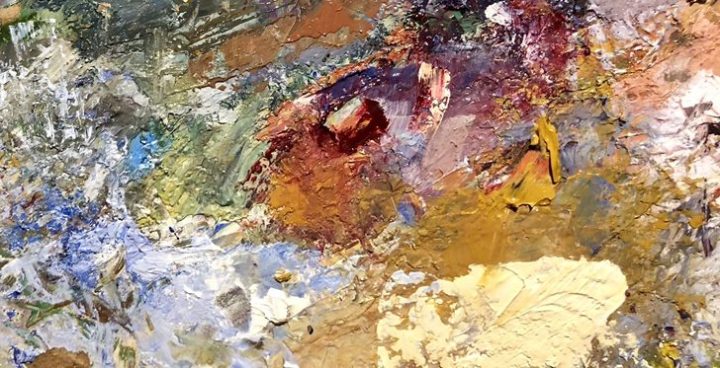
For the last few months, my life has felt more chaotic than one of my over-used palettes.

For I’ve struggled to hold a brush or stay awake after work long enough to fire off even the tiniest of posts. For a while I thought that grief over the quarter million Covid-19 fatalities just in the US or worry about the election that’s now almost behind us was sapping my creativity . Then, just as I started an online Special Educator teaching job, my second bout of pneumonia this year roared through my lungs while anemia from a chronic illness sucked the strength from my limbs and psyche. The combination left energy only for the essentials – job and making sure the one kid still living at home is fed and reasonably clean.

This morning, as I sporadically checked the election returns, however, I decided that, instead of worrying about the results, I’d get out of bed and work on my lessons for the coming day. As I pulled together interactive Google slides and Kahoot games, I realized that, just because I haven’t had a brush in my hand, doesn’t mean there’s been no creativity in my life. It’s just been going towards making sure kids who are struggling can read and do math.

As I put together a game board for one of my reading students, I thought about how much progress she’s made in just the last month and how far she’ll go long after she’s forgotten most of her 5th grade teachers. As I imported game pieces into the Google slide we’ll use later this morning, I felt like I was casting another vote for hope in her future and ours. I’ll keep doing it today and the next day and the next, regardless of who the next president is. Not voting for her future — and all the other kids who are just discovering their gifts – is not an option.

The nature of chronic illness is that it comes but it also goes, and when it does, there will be more energy for creativity in the other parts of my life. For now, creative voting in the Zoom classroom is enough.

One Battle, Many Fronts

I’ve been sending out resumes for weeks, but today was the first morning in weeks that I set an alarm. Job searching is rolling a rock up almost to the top of the hill each day just to watch it crash into a ravine as the sun sets. It’s a slow-drip infusion of limbo, and last night, as the first hint of fall air blew through the window I realized that anesthetic has had me sleepwalking through the summer. 

But summer is almost over, and it’s time to pull out the IV and fight back.

For most of my creative life, I’ve been refereeing a tug of war between my writer side and my artist side. Last night, as I began thinking about the best plan of attack, that tug of war — fed by the knowledge that I can’t serve two masters — threatened to become a quagmire.

I sat trying to choose between two passions until I looked at my empty calendar for the next day and realized that the only master I should be serving is creativity. There may be many fronts — writing, gardening or painting  – but the battle is for the creative life.

Before I went to bed last night, I made two dates for today. The first, as soon as the sun and mountain mists would be moving, was with Mt Equinox and a canvas. The second was with my blog and the short story folder on my laptop. By the time the alarm went off and my easel was packed, limbo was in full retreat.

A Way Out

I was already stressed by the time we got to the checkout line yesterday. 

It was the first time since the start of the pandemic that both boys and I had been to a store together, and standing in line made the afternoon feel like a holiday. We chatted with another middle-aged mom and a younger mom carrying a 6-month-old in a snuggly. The mundanity started to soothe away the anxieties wrought by a frustrated job search, financial worries, and waiting for further news of my mother who was in the hospital two states away.

The summer has been filled with the same stress that millions of people are feeling — job searching, isolation, illness, and, this year, a void. 

Circumstance has tied my life in knots, strangling my creative life. My garden has been a practical canvas of sorts, but, for most of July, my easels and my laptop (except during job searching) have been closed.  Lung pain made painting physically impossible for most of the spring and early summer, but lately a different pain has kept me from writing or painting. 

Mania makes me powerful as it burns out unpleasant details, but my depressions throw them into sharp relief with every disgusting reality glaring back at me. I see our planet melting. I see the powerful sacrificing the weak on the alters of profit, making me wonder if any lives — especially those as trivial as my own – matter. The clarity is painful, and the pain feeds on and expands my void.

Thing1 and Thing2 were waving at the 6 month old who seemed fascinated by their brotherly banter. Above their masks, I could see the other mothers smile. Covid-related cleaning extended the wait, but everyone seemed to recognize the preciousness of this bit of normal. 

Shouting from the cell phone section a few hundred feet away shattered the normal.  

At first we thought someone was arguing over masks, but Thing1 and Thing2, towering over the shelves in the checkout aisle, reported an argument between a group of shoppers and a manager.  A thud echoed through the store as someone threw something, and four men, one of them carrying a well-stuffed black garbage bag, ran toward the exit near the cash registers. Someone yelled to call 911 as a manager yelled at his employees to lock the doors. 

Realizing we were witnessing a robbery, I tried to maneuver my kids behind me and looked for the younger mom who was also looking for a place to escape or hide her baby. Thing1 and Thing2 have never witnessed or survived an armed robbery. I have. Knowing the prevalence of guns in this country and not caring how many phones or electronics might be in that garbage bag, I held my breath as the fleeing men got closer to the doors and the registers and prayed the employees wouldn’t be able to lock the doors. 


The men and the garbage bag barreled through the doors before the employees were able to force them closed. Cashiers returned to cashing people out as supervisors called 911 and tried to get descriptions. I asked the boys and the other mother if they were ok and noticed my own hand was shaking as I retrieved my credit card from the card reader. 

We left, and the boys focused on burgers more than burglary.  Adrenaline got me to the take-out place safely, but it also became a filter. Sometimes a story on the news will trigger a flashback to another robbery twenty-eight years ago when, lying face down on a beer-soaked carpet, I wondered if our assailants would shoot us in the head or the back before they left with our valuables. I’ll feel damp and my limbs will go numb, but, as I sat in the car, watching my kids eat and goof off, trading inappropriate jokes, I stayed with them. I stayed in the now. 

New blog post ideas started popping into my head.  As I started the drive home, I noticed, for the first time all summer, the layers of green and gold and white in the landscape. Suddenly the landscape – and life – didn’t seem trivial. 

I’ve navigated my depressions for years using cognitive lifelines, but responsibility to my kids, rather than creativity, is usually the first one I grab. Yesterday, our trip through the ordinary and the newsworthy knit those lines together and gave me a stronger way out of this depression.
Garden Surprise

One of things I love about having two kids who are getting older (one is almost 20 the other is almost 14) is that, as their different strengths emerge, I am ending up with two very different and wonderful partners in crime.

Thing1 one is my builder. I contract more and more construction projects out to him these days.

Thing2 is my idea man, my co-dreamer. When I have an idea for a backyard project that might make Thing1 or the Big Guy gasp in horror, Thing2 is ready to hop on that flight of ideas with me which that’s how I ended up with today’s menu specialty, Garden Surprise.

Last summer the two of us were shopping and stopped at the food court for mango smoothies. We both decided they were so good we had to have seconds, and just before total brain freeze started to take hold we uttered, at the same time, “we should get a blender so we can make our own.”

Now I know what you’re thinking. There should’ve been a responsible adult there to put the kibosh on this idea, but five minutes later we were headed over to the kitchen store to pick out a blender. We bought a bunch of frozen fruit at the grocery store and did a little experimenting. Almost as soon as we stocked the freezer and perfected a few blends, however, cold weather set in, and the blender didn’t see much action for the next nine months.

We’ve had a few barnburners recently, and the frozen fruit and blender have re-emerged but with a twist this year. The last few days, as the garden really starts to produce, I’ve developed a new recipe, Garden Surprise, which consists of water, protein powder, a little bit of frozen fruit or banana, and anything that happens to be ready to pick. It’s yielding wildly different drinks from day to day–today included kale and cilantro and peas, but, just as i’ve learned from my two very different boys, sometimes the things that take you most by surprise also offer the most joy.

Exposed to Nature

When we first build the crazy cave we call our home, we had a zillion things on our wish list. Solar panels. A wind tower. Tinted concrete for the flooring to maximize our solar gain. An outdoor shower. A garden. We ended up with the solar panels and the garden, but, by the time we moved in, our finances had whittled our wish list down to a stump.

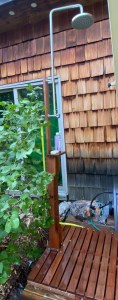
To be sure, the outdoor shower is nothing new around our house. The Big Guy has a well-publicized history of taking advantage of a summer rainstorm to rinse off the sweat from a day of working around the house. As Covid-19 has sharpened our focus on home improvement, however, the idea of semi-permanent place to hose off garden dirt and sweat before traipsing through the house started to take shape again.

Over the years, little shoots have emerged around that stump. We’ve painted and connected to the grid. We’ve moved a door and rearranged rooms. We’ve had chickens and a host of pets and mice. And, this summer, we added an outdoor shower.

My folks installed an outdoor shower at their place years ago to minimize tracking in sand, so our family is no stranger to sudsing off under the sun. We’ve watched as their privacy enclosure has evolved and the family has adopted a policy of not looking out ‘that’ window when crowds of grandkids returned from the beach.

We’ve had a few scorchers this last week, and every day of labor in the garden ends with a quick jump in the frigid river, followed by a rinse in the shower. Our privacy protocol and enclosure is still evolving, so I let the boys go first and, once they were inside, I stepped on the wooden shower pad. The shower is attached to a hose and is invigorating as you’d expect, but it was warmer than the river, so I took my time cleaning up.

I shampooed and chatted with the chickens as they scratched the nearby weeds. I kept a watchful eye on the forest just incase a peeping YogiBear might be out there and then giggled as I rinsed. turned off the water and enjoyed getting a little exposed to nature.

But seriously, our enclosure needs to evolve and quick.

The Chickens and The Eggs

By the time I got back from the garden with my daily blueberry harvest, something had discovered the wild black raspberries by the woodshed, stripping the lower canes of every last bit of treasure. I picked the last half cup of berries by the shed and then did a quick lap around the yard for an informal inventory. At every point, the lower canes had been henpecked out of their bounty. I had almost completed the lap when I bumped int the culprits and an age old question – which comes first, the chickens or the eggs?

We don’t cultivate black raspberries or blackberries. They cultivate themselves — usually in the most invconvenient spots – but we do try to harvest enough for a small batch of jam or berry pancakes each year. They’re one of a few crops we don’t have to work for.

Eggs are the other crop we do very little to nurture. New chicks get a starter feed and, as soon as they’re old enough, a coop on the range. Advocates of letting chickens be chickens, we’ve been letting the Ladies of the Coop dictate what they want to eat, and, until the berries ripened, that worked out pretty well. They seemed to go mostly for bugs and weeds and, aside from “aerating” the carrot bed a little too enthusiastically, left most of the garden plants alone.

Letting chicks be chicks has, historically, given us delicious eggs with rich dark yolks. Blackberries are just starting to form and ripen. I suspect the Ladies of the Coop will be aiming for that crop as well. Part of me wants to try to fence off the canes to save it for the humans. The other part of me is coming to terms with the fact that getting great eggs may mean letting the chickens come first. 

Salad Days

The last few months have been sketchy for me as the demands of mitigating the pandemic and navigating pneumonia with resulting lung issues forced me into a new job search. I am determined to continue teaching in the fall, but, along with millions of other Americans, I know that full time employment is anything but certain. Daily, I fight the paralysis of angst as I try to reconfigure my safety net in an unstable economy, so it sometimes seems counterintuitive that my primary source of serenity would come from the ever-evolving vegetable garden.

I am no longer, as the bard would say, green in judgment, but these are still my Salad Days — chaotic and nerve-racking.

Last evening I wandered through the garden, noticing new buds and gathering treasures. A short while later, a black bear wandering through the garden cut short a visit to the composter and the driveway. It knocked over a barrel but left the chickens alone. I immediately knew who was responsible for knocking down trellises and eating cucumbers as soon as they form, but I wasn’t mad.

I was amazed, and the giddy amazement that comes with remembering that bears surround us in Vermont (there are over 4500 of them) got me rethinking the things I can’t control. Weather and wildlife may exercise as much control over my harvest as my work, but the chaos isn’t always destructive.

Sometimes chaos is a wakeup call. It’s the change that lets me see the new lettuce flourishing and the wild black raspberries volunteering their surprises. It’s the chance to marvel that wild things still exist in this part of the country. It’s the force that refocuses my attention on the people who need help and the planet that needs people to live deliberately. It may upend parts of my life, but, as with the weather and wildlife, I am working harder not to fear change, but, at an age when many people seek calm, embrace it as a chance for new experience.

Chickens in the Jungle

Joan Jett here is on her second walk about on the jungle on the side of our house. Seeing the other girls are on their second day of exploring the wonders of free ranging. We have to wait until the cats are in the house–the chickens are quite big enough to disinterest the cats, who are basically bullies.

The americana’s all have names. Fluffy is still Fluffy because of her lovely Maine. Joan Jett has a shocker black feathers at the top of her head and is quite the troublemaker. I was going to name the last one Goldie because of her feathers, but the Big Guy insisted on Golda, Keeping with the tradition of naming the checks after bad ass females.

They’ll scratch and explore for a while and then, hopefully, wander back to their tractor as I did yesterday for an afternoon nap after all their exercise.

It’s funny to watch chickens when they’re allowed to be chickens. The pecking order isn’t solid. They like to cuddle. Some of them like to those in the sun while others can’t stop preening. we’re trying to walk the fine line between protecting our chickens and keeping them from being chickens.

The First Thing

About five years ago I was invited to lead a drawing workshop for a group of teenage boys recently arrived to this country as refugees. I had never taught anybody anything and knew nothing about classroom management. I understood the workshop would be an education for all of us, but some of the lessons of that day have only recently become clear.

The boys were attentive and engaged with the workshop. By the end of the class, they had filled the pages of the sketchbooks I’d brought with drawings of trees and garden statues. As their confidence grew, some of them began to sketch their lives as refugees.

Those very personal drawings often depicted experiences no human, especially no child, should ever have to endure. When I got beyond my outrage at the thought of a child having to hide from people with machine guns, however, I wondered if the resilience of these boys was the most valuable lesson I would take home, but my education was only beginning.

A few years later, I began working with students with complex trauma. Many of the students came to us through the juvenile justice or foster care systems after experiencing years of assault or extreme neglect at the hands of parents or trusted caregivers. Some students tiptoed into the program, scanning every room they entered for threats and jumping at the sound of a torn piece of paper. Other students raged against their lives with profanity and destruction.

These kids take months and years to navigate far enough around their trauma to be able to build their futures. Some never get around it, and, when I first started this work, I wondered how the boys from the workshop who had survived war circumnavigated those memories, seemingly, so much more quickly.

When Thing1 was born, I morphed, in the space of 36 hours, from an ambitious, tech-driven programmer to a bowl of pudding that wanted nothing more than to hold my child until he no longer wanted to be held. At the time, the Ferber method was still very popular, but something felt very wrong about not picking up my child when he was crying. I asked a social worker friend if I should just have Thing1 ‘tough it out.’

My friend put her hand on my arm and said, “Rachel, the first year is about establishing basic trust.”

I never forgot that. Establishing and keeping trust with Thing1 and Thing2 became my parenting touchstone.

Studying education, I read Erik Erikson, the psychologist who promulgated the stages of psychosocial development starting with that first year or so of basic trust. It was bias confirmation, but, as I met more children healing from trauma, I wondered if the loss of trust reset those stages of development. 

Last year I drafted my family into a 5K to raise money for charity. The race, an hour away from our house, gave me a chance to talk a family member and child psychiatrist about the different trajectories I was seeing.  I asked him if the breaking of trust by a parent or trusted individual such as a teacher or police officer cause a more profound or permanent trauma than experiencing atrocities by people who make no secret of their bad intentions.

He didn’t a quick answer for that question. He didn’t have easy answers to the more difficult question of how we help people recover from that trauma. I still suspect there are no easy answers to either question.

Working with children who have been betrayed by people they should be able to trust has brought the lessons from the workshop full circle, showing me that rebuilding a life is begins by addressing the first thing all humans need– the ability to trust.

Leading with Love

Every morning when we bring out the checks, Katie follows us. She watches and whines, urging us to be careful as we move the growing babies from indoor enclosure to box to the chicken tractor outside. She trails the Big Guy from room to outdoors and hovers as he releases the checks into the tractor.

When the chicks are settled in their outdoor home, she’ll sniff on all four sides, inspect the sky to see if any predators are selling above, and then give a pointed look at Jim-Bob, as if to say, “Don’t mess with my chicks”.

most mornings she’ll lie down next to the coop, watching the chicks scratch and argue over who gets this would chip in that white fluffy flower. To be sure, Katie has her explorations in the woods. From the moment the chicks are in the tractor, however, until the moment we begin moving them back into the house, she lets us and them –and even the cats – know that she is there to protect and serve.

She never growls or bares her teeth at anyone. when she sees Princess Jane get too close to the coop, she will physically move herself between the chicks and arrow little gray huntress, but there are no snarls or parks. When it counts, she firm but always as loving with Princess Jane as she is with the chicks.

No one will ever mistake Katie for a huntress or vicious guard dog, but as a vigilant and caring protector, she’s becoming quite good at keeping the peace.

White Noise

There are times when you keep silent, knowing that whatever you could add to the conversation would just be more noise. There are times, however, when not making noise is giving silent approval to things that make life unlivable for people around you. This has almost never a blog about politics or society. It is mostly been about family and being a mom, and that is precisely how I knew I had to make noise. It is why I could not be silent about what has been happening to other families in Georgia and Louisville and Minneapolis.

I’m white. I live in a predominantly white state. I may have family and students of color whom I love and with whom I can sympathize. As a teacher, I can make sure that a diverse set of voices are represented in my curriculum. I can try to empathize, but I know that even empathy can’t impart how it truly feels to walk a mile, let alone thousands of miles, in any of their shoes. I know that, as a middle-aged white woman my skin color is armor. 

I first recognized the privilege that armor endows about 25 years ago, when, dressed in my grumpiest clothes and filthy vacation hair, I stopped at a convenience store to stock up for a road trip home. I wandered through the store, pulling items off shelves and putting them in my pockets as I browsed. The storekeeper ignored me, instead trailing one of my well-dressed but much darker traveling companions. I have seen it numerous times when being stopped for a broken taillight or blinker. The police officer watches me dig through my purse and assumes I’m looking for my license rather than a weapon. I was reminded of it again this week, watching with the world as another white woman deliberately weaponized her privilege against a birdwatcher of color in Central Park. 

I have also heard my privilege when listening to mothers of children of color and realizing what we have very different conversations with our children. We all tell our children to obey the law, but I tell my kids to know their rights. I’ve heard other mothers talk about the law but also about ensuring that her child knows all things he must do, about when and where he should or should not go to earn the presumption of innocence that my sons take for granted as their birthright as citizens.

 This month, I’ve also been thinking about the conversations no mother should have to have about her child. There’s the conversation that her child was executed in her own bed. There’s the conversation that her baby was gunned down while jogging. And there are the conversations about the killers who enjoy the presumption of innocence that their children never got.

 So I’m making noise. I’m bearing witness. Black lives matter. Black mothers’ children matter.