Seconds, Please

Order 8 x 10 Print[nicepaypal type=”cart” name=”Pie 8 x10 Print” amount=”20.00″]
Order 4 x 5 Card [nicepaypal type=”cart” name=”Pie 4 x 5 Cards” amount=”5.00″]

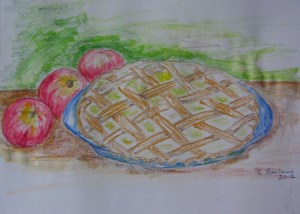
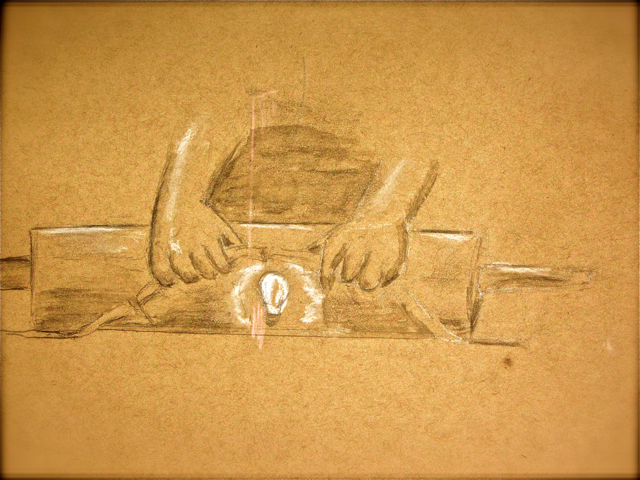
So, this isn’t profound or anything, but I’m forty-something, and only in the last two weeks of my life have I discovered how much a pie crust benefits from a good rolling surface. It’s changed my baking life.

I don’t know whether my pleasure over this discovery is pathetic, or if I should just be happy that at the tender age of forty-something I’m still discovering something new about pie.

I’ll figure it out over desert, I guess.

The Sweet Taste of Serendipity

Order 4 x 5 Card [nicepaypal type=”cart” name=”Suitcase 4 x 5 Cards” amount=”5.00″]

I used to think we were really green in our lifestyle; now I realize we’re actually just cheap.

We got off of oil partly for environmental reasons, but we were really just tired of paying a bill that seemed increasingly out of control.  We garden partly because we like organic food, but I really get the most satisfaction out of having dinner makings 20 feet from my door rather than 15 miles away at the grocery store.

But, whether we do what we do because we’re charitable or cheap, an appetite for spontaneity has been the key to sustaining our sustainability.  Sometimes the appetite didn’t need whetting – like when a neighbor drops by with bucket full of acorn squash.  But other times – when the bucket is full of the same zucchini that we’ve already grown weary of – serendipity is an acquired taste but one that we both try (and try to force our kids) to appreciate , even when it takes some effort.

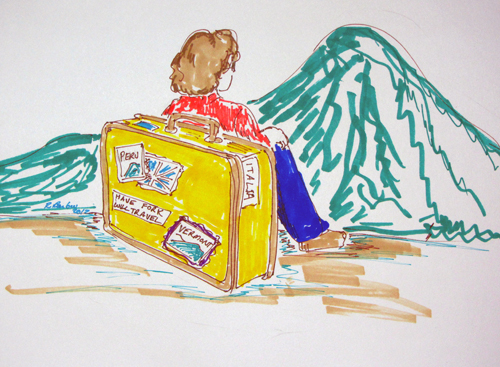
Most people my generation were raised by parents with their own childhood memories of the Depression, and I doubt even my kids and their friends have escaped hearing a chorus of  “There are starving children in…. “.  I only began to understand that refrain – and to appreciate the flavor of fortune when my parents briefly moved us to Peru when I was in the fourth grade.

We had lived there once before when I was five.  My parents rented both times, and both times they continued the employment of the housekeepers who had worked for their landlords.  They stayed in touch with both women long after their stay in South America, even corresponding with some of their children and extended family.  During our second extended stay in Lima, our first housekeeper invited us to her house for dinner.

We had been there before, but I hardly remembered the  first visit, and I still remember being shocked when we drove to her village and walked into a house that consisted of a few semi-finished walls of brick and several woven walls.  The entire structure was not much bigger than an American living room, but it housed her entire family and their chickens.  We knew any inappropriate comments would result in swift and severe reprimands, but we also loved this woman (she had taken care of us when we were much younger), and her chickens fascinated us.

My sister was going through a noodles and ketchup phase that year, but my parents had (and still have for their grandkids) a  rule that you had to try at least one bite of everything on your plate (which they loaded of course).  We had had mostly good experiences with Peruvian food, and we were usually – but not always – happily compliant.  For this visit, however, my father quietly made it abundantly clear that the one bite rule would be expanded to cover everything on our plates.

As it happened, she served us a Peruvian version of Arroz con Pollo, made with one of their freshly-killed chickens, and I remember easily cleaning my plate. Later, as we drove home we talked about the house and the chickens and of our hostess’s kids.  And when the conversation turned to the meal itself, my father mentioned that the food she had prepared for that one meal was more than most families in that village ate in a week.

Thinking back on it now, I realize their efforts weren’t just about expanding our palates and our world (although our stint there definitely did that).  They were trying to teach us not only to take advantage of opportunity when it presented itself but also to fully appreciate it when we did.  I took that lesson with me wherever I traveled.  And, while we will never know the level of poverty we saw in that village, being able to appreciate opportunities of all flavors has helped us sustain our lifestyle and, sometimes, our family.
Bluster at the Border

Order 8 x 10 Print[nicepaypal type=”cart” name=”Stick Season 8 x10 Print” amount=”20.00″]
Order 4 x 5 Card [nicepaypal type=”cart” name=”Stick Season 4 x 5 Cards” amount=”5.00″]

Today was the end of the beginning.

It began with balmy bluster; a steamy day that, despite the heat in the morning, was seeing the surrender of much of the fall foliage. Sporadic gusts sent leaves skipping down the church lane, and Thing1 and I worked quickly, hoping to get the canopy up and secured before the forecasted showers arrived.

The sun made a brief appearance just as we finished getting my Harvest Festival booth set up, and when the sun went, so did summer.   Brief showers punctuated the rest of the day, and, as the temperature dropped, the talk among the vendors turned to snow.  We had all heard rumors on Friday (the ladybugs swarming on our screens are warning enough for us), and, when the crowd dissipated  as it always does on a rainy festival day, debates on the merits of a ‘real’ winter abounded.

But for me, regardless of the first snow date, today’s crumbling avalanche of color was really the end of the beginning of fall.  And when the colder gusts strip the trees bare, my favorite season – stick season – begins.  It’s when the wind and the fire in the evening sky whip the trees into an extended feverish dance and when that dance inflames the imagination.

Most of the day I under my hermetically sealed canopy, nervously watching the skies as the crowd fluctuated and hoping my pictures would be spared during any deluge.  The rain, when it came, was brief .  But when it was over, and when I had restored order to my wind-blown booth, I stepped out into the lane.

Vendors had donned jackets and even hats.  There was a bite in the air, and suddenly the trees were more naked than not.  And I knew the bluster had brought us to the border of something even better.

My Cat Phase

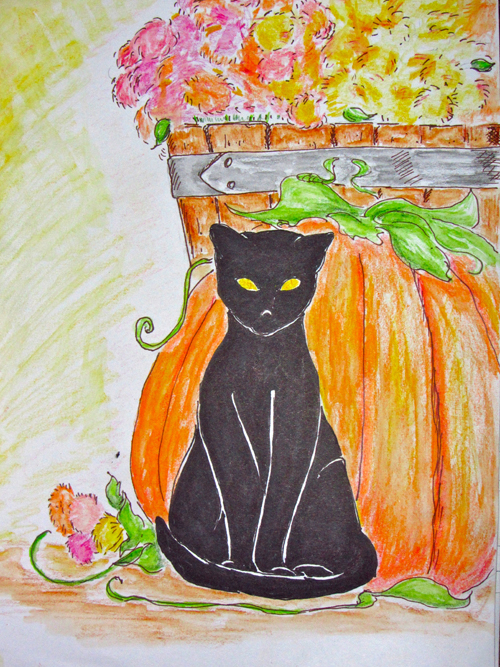
Order 8 x 10 Print[nicepaypal type=”cart” name=”Harvest Cat 8 x10 Print” amount=”20.00″]
Order 4 x 5 Card [nicepaypal type=”cart” name=”Harvest Cat 4 x 5 Cards” amount=”5.00″]

There’s no point to this post, but apparently I can also waste a lot of time staring at our cats.

I think it’s jealousy.  I am totally envious of any creature that can come and go at will, feed itself and find a place to flop when it’s bored or tired of feeding and looking after itself.

Retro

The falling leaves are bathing Vermont in antique gold, and lately I feel as though I’ve entered a malfunctioning time machine that teases me with glimpses of the past.   Leaves and, soon, snow are coming to cover the painted yellow lines on the asphalt, camouflaging the trappings of the twentieth century.  But this only heightens my curiosity, not about the recorded history of the area, but about what life was really like.

In some ways, our off-grid, out-of-the way life gives us unique peeks into an older lifestyle – we heat and cook with wood, we grow and put up some of our food, we hang all of our laundry on the line.  But every time I pop a tube of roll up cinnamon buns or hamburger helper in my shopping cart, I wonder how ye old housewives managed to do all of this by hand.

I loved the Little House books when I was a kid, and Farmer Boy, the one about Laura Ingalls Wilder’s husband, Almanzo, as a boy, actually took place not too far from here – you can visit his homestead in upstate New York.  The story of their family was fun, but my favorite parts were always the copious descriptions of how Ma and Pa put up a house, a garden, a bear they just killed.

It’s at this time of year when I’m freezing instead of canning the last goodies from the garden or when I’m nurturing my inner slacker mom in other ways that I most often think of Laura’s Ma, and the detailed description of Almanzo’s Ma – the original SuperMoms – raising a sizable brood of super-obedient kids in nearly pristine houses stocked with food they grew and furnished with homemade furniture covered with homemade quilts.  I don’t just wonder what it was like to be them, I wonder if there was something magical in the well water back then.  I get exhausted driving my saucy kids (no idea where they get it) to school, bringing home part of the bacon, and trying to keep the house just neat enough to keep from being condemned.

I don’t yearn for life in that “simpler” era.  I like antibiotics and being able to vote.  But I would pay good money to know their secrets.

A Little Mountain Music

A Little Mountain Music

Order 8 x 10 Print[nicepaypal type=”cart” name=”Mountain Music 8 x10 Print” amount=”20.00″]
Order 4 x 5 Card [nicepaypal type=”cart” name=”Mountain Music 4 x 5 Cards” amount=”5.00″]

 One autumn Saturday night a few years ago a dinner guest sat down at our piano and began picking out a tune from one of the songbooks he had found in the bench.  We were between dinner and dessert, and, as I was loading, the Big Guy pulled out his guitar and pulled up a chair by the piano.  The two moms finished putting away food and dishes and joined the musicians in the alcove near the kitchen, and we played and sang until all of our kids were passed out on the couch nearby.

It was the most action that piano had seen in months, and it was to be the beginning of a change in perspective for it and all of us.

Shortly after that night we began rearranging cabinets and furniture in our kitchen/living area with the hope that we would be putting the finishing touches on a house we had built five years earlier.  Our breakfast table changed spots five times.  I rearranged cabinets and tag sale buffets in every possible combination, trying to make the most efficient use of space.  And, in all of my arrangements, our piano occupied a new, more prominent position in the center of the living area.

We had several dinners with the same couple – our kids are all in the same age range – and, after solving the world’s problems over meals of varying formality, we continually ended up at the piano, looking through the songbooks for something easy to play and familiar enough for all of us to sing most of the words.  We never planned these music nights, until a few weeks ago.

We had spent the day managing a multi-family tag sale, and everyone – including the kids – was exhausted.  Somehow, however, we found ourself gravitating to the piano once again, and it was then that we noticed that one of our younger guests had brought a trumpet.  People started to perk up.  Thing1 got his guitar out.  Thing 2 found a recorder (a dubious blessing most nights).   And it started to dawn on us that music night was now an actual tradition.  We said goodnight with plans to do it again, sooner this time.

Now, the Rolling Stones and the Carters have nothing to fear from our little improv group – most nights we’re picking through tunes note by note (although we had started picking songs ahead of time).   But when we’re crooning and carrying on, I often think the critics and crepehangers of the world should be shaking in their boots.

Surrounded, as we all are, by a cacophony of can’t, it is easy to assume that not only shouldn’t we congregate and question and discover but that even the trying is beyond us.  But when we do try, not only do we discover that we are capable of entertaining ourselves without direction from the arbiters of trend.  We find that, as Cat Stevens once wrote, we can sing out if we want to.  And when we do, we make ourselves free – at least in a small way.

Ma Barlow


One of the disadvantages of living in an earth sheltered house is that a lack of planning can cause unusual conundrums.

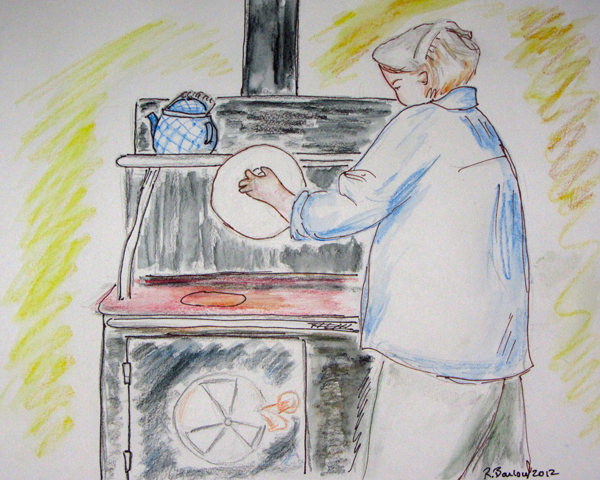
Today was the the perfect example.  I was pulling things out of the fridge for dinner and noticed that we were out of propane. It is fall, and in our old colonial farmhouse I would have automatically fired up the woodstove and made a stew.  Our current woodstove is even better for these situations – its massive oven and cooking surface make me feel like Ma Ingalls whenever I start it – but wasn’t the perfect solution in this house in this weather.

It’s jacket weather outside, but between the low-hanging sun blasting our house with heat and the three feet of earth on three sides keeping it in, the house was already 71 with no additional help.  Lighting a fire hot enough to cook with would not have made the place more comfortable.

So now it’s 6:15 PM, and I’m standing in the kitchen of our earth-friendly, earth-sheltered house trying to decide between making sandwiches or doing the ultimate ‘un-green’ thing by opening all the windows and building a fire.  I’m rationalizing – it’s going to rain tomorrow and the fire will give us hot water, so it’s not a total waste.

I’ve stopped pretending that our off-grid lifestyle is as environmentally altruistic as it is self-serving, but we do like being green when we can .  Sometimes, though, figuring out how to do the green thing and still get dinner on the table and homework checked can be a real head-scratcher.  I was still scratching my head when the Big Guy waltzed in the door and announced he had finished switching the tank on the stove.  Tonight getting dinner on the table without wasting our wood heat became the green thing.

Patchwork Season

Order 8 x 10 Print[nicepaypal type=”cart” name=”Patchwork 8 x10 Print” amount=”20.00″]
Order 4 x 5 Card [nicepaypal type=”cart” name=”Patchwork 4 x 5 Cards” amount=”3.00″]

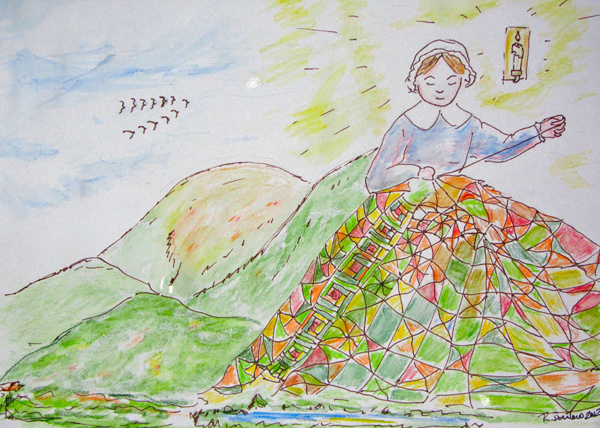
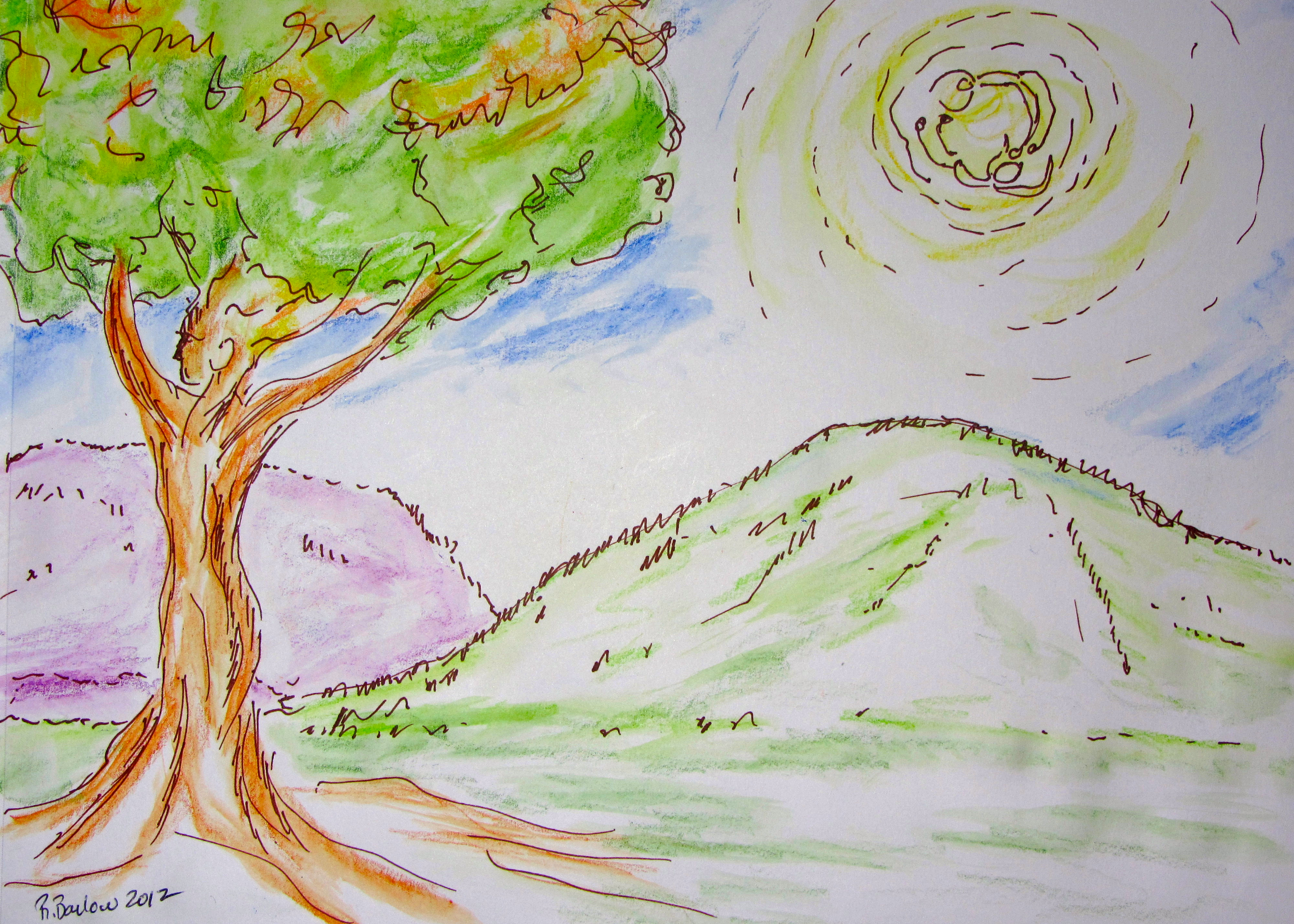
Have I mentioned I love the light at this time of year?  Every time I head out our dirt driveway, I have to slam on the brakes to catch it as it bounces off the mountains in their increasingly flamboyant colors.  The tableau only gets better as I head  towards the horse farm at the bottom of our road, and the wooden fencing recalls an earlier era.

I know the first settlers to this area saw these same mountains, but sometimes I wonder if, in the struggle to survive, they had the chance to marvel at them very often.  For us, autumn is beauty, but it is also a time of stacking wood, clearing out the garden and mulching, and getting fall cleaning started (sometimes done).  And, as our action-packed to-do list dominates our calendar, I sometimes have to remind myself to stop and look around.  It begs the question, was stopping to stare at the scenery anywhere on the priority list in 1763 (that’s the year carved into a ceiling beam in our old house)?

About a year after we moved to our neighborhood I got my answer.  When we moved to Vermont, I found a group of women who were avid quilters.  They were true artists, but my knowledge of the art was very basic, and I headed to the library (there weren’t many quilting websites back then) looking for inspiration, instruction, and easy patterns.

What I found was a chronicle of thrift and creativity interwoven by women.  I still look at early examples of the craft in Vermont, amazed at the designs conceived by women who often had less than an eighth grade education.  But what was most interesting was the way many surviving patterns so beautifully mimic our shared landscape.

I was on this journey of discovery on the months following 9-11.  As world events unfolded, our nation considered how to protect simultaneously its citizens and its identity,  and sometimes it seemed as though we were all just focusing on surviving.  I realize now we were all in an extended state of shock.  At the time, however, as the feeding of our collective soul became an afterthought, I often worried that the national hyper focus on security had eliminated everything but utility from our consciousness.   And, it became even more important to me that these people I had never met had been able to do something more than just survive.

Today as I drive up the road, watching the colors climb down the hill to meet me, I am connected to the women who were here before; whose homespun legacies suggest lives that were inspired and not just mere existence.  And, as I have come find in my own life, that inspiration may have fortified their strength when survival became more challenging than usual.

Letting Awe In

Order 8 x 10 Print[nicepaypal type=”cart” name=”Awe 8 x10 Print” amount=”20.00″]
Order 4 x 5 Card [nicepaypal type=”cart” name=”Awe 4 x 5 Cards” amount=”3.00″]

This morning the purple clouds against the orange trees filled me with awe.  It was a perfect blustery fall day, tailor made for a fire – even if I didn’t need one.

As the day wore on, however, I learned of friends who were now enduring health issues – some temporary setbacks, some life-threatening.  I learned of friends losing friends and almost losing friends.  And the day outside my window seemed to mirror theirs, and I forgot about awe for a while.  And then I learned of a friend whose life has just been forever changed by the suicide of a loved-one, and I quietly broke down.

I walked out to look at the sky and trees again, thinking of the day almost thirty year ago, when a close friend changed – forever – the lives of everyone in our group of teenaged misfits by taking his own life.  Already trying to cope with mental illness that had plagued me from early childhood, our friend’s death sent me into a nearly-fatal tailspin that was only halted when a dear friend forcefully intervened.  You know who you are, and I don’t think I’ve ever said, “Thank you.”

Thank you.

That event coupled with Olympian denial on my part led to a sustained, sometimes intentional, retreat from meaningful interaction with family and friends, and any emotions that required honest reflection.  I found my highs in dangerous places and people, and crashed often.  And only when I stopped to let awe in – watching a sunset or enjoying a celebration as a spectator – did I ever admit how meaningless life was becoming.

You can keep barriers up in a marriage – not for long if you want it to be successful – but you can for a while.  You can’t, however, have barriers of any kind if you want to be a good mother.  Giving birth completely obliterated mine, and I have never had a chance to fully reconstruct them.

Surrendering my defenses, opening up was the scariest, best thing I did.  It let romance with my husband become real love that endures the worse and the poorer.  It let me completely subvert my wants and needs to another human being and be happy doing it.  And, today, it let me cry thinking of my friends, hoping their healing will be swift and complete.  And, as I went outside again at the end of the afternoon, it let the purple sky and orange leaves still fill me with awe.

Mom and the Apple Pie

It’s the Big Guy’s birthday, and I’m making apple pie.  He and Thing1 eschewed birthday cake in favor of pie a few years ago, so after a day of excavating our mudroom (perfect birthday activity), I pulled out the Joy of Cooking and started making the crust.  I go back and forth between the Joy of Cooking recipe – is it possible to use that and not think of your mom – and the one in the Good Housekeeping Cookbook, but, as I was peeling apples, I remembered I was out of the lemon called for by both of these recipes for ‘Classic Apple Pie’.

It’s amazing how your mind wanders when you’re peeling apples, and mine usually has a good head start anyway.  I was on the 3rd or 4th apple I started wondering, not if  I should make a dash to the country store – but how Classic Apple Pie became a classic.  It’s the quintessential New England dessert in fall – every year we get so many apples that we sometimes have pie or apple-something every night for a mont.  But, almost without fail, most Apple Pie recipes call for lemon juice.

Now, I know Joy of Cooking has been around for a long time, and it was certainly possible to find lemons in urban areas of New England even a century ago, but our town had year-round residents living the original off-grid lifestyle just 50 or 60 years ago.  There was a country store – the one we still shop at – but it’s hard to believe lemons were a commonly stocked item then, and certainly not 100 or 200 years ago.

Now, I’ve learned not to use dinner guests as culinary lab rats, but I figured the Big Guy might want to eat adventur – I mean, authentically – on his birthday.  I started thinking about what the earliest European settlers would have used for their Pie.  I planned to google it later, but it was getting late, and I opted for experimentation over transportation.

I figured a mountain mom who made it to the country store every few weeks or so might have kept flour, sugar, and molasses, and maybe some kind of spices on hand.  They would have had milk and butter, of course, and probably some kind of lard/shortening.  But not a whole lot of lemon.  Now, Julia Child’s mantra may be ‘Keep Calm, Add Butter’ (an admirable outlook on life), but in Vermont the rule is, ‘When in doubt, add maple syrup’.   I figured that tradition was probably established early on and decided it was a good substitution.

Later, as I sat on the couch smelling the results of my experiment bubbling in the oven, I did a quick google and found that Apple Pie goes back in history as long as apples and flour were in existence.  Some old recipes call for champagne in place of lemon, others were just apples mashed with flour.  Apple Pie a la Mode made its first appearance at the Cambridge Hotel in Washington County New York in the 1890s, and the phrase ‘American as Mom and Apple Pie’  was coined in World War II.

But whether it was mom or the cook in the castle kitchen, experimentation was the most common component.  The pie pan emptied quickly, and in the end, the family decided that it was also the most delicious ingredient.