To anyone getting the last post twice. My provider had a power outage last night, causing some data to be lost and then reposted.
Blog

In Spirit
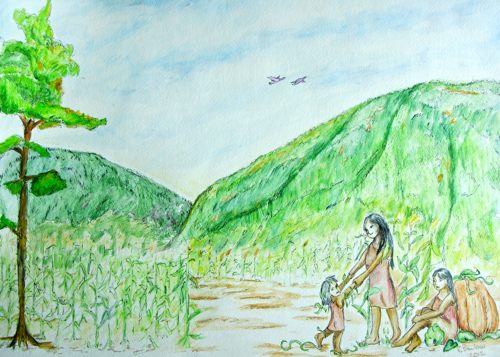
Three Sisters
Order 8 x 10 Print[nicepaypal type=”cart” name=”Three Sisters 8 x10 Print” amount=”20.00″]
Order 4 x 5 Card [nicepaypal type=”cart” name=”Three Sisters 4 x 5 Cards” amount=”3.00″]
I love the light at this time of year. Throughout the day, the acute angle of the sun bathes the trees and garden in a pinky-gold, giving even our contemporary cave an antique atmosphere. I think it’s that sepia glow that always gets me wondering about the property’s previous caretakers.
Thing 1’s history project a couple of years ago put a new perspective on my wonderings by sparking an interest in genealogy. We were looking for Revolutionary war figures to report on and shaking the family tree a little helped a few ideas fall out. I began tracing the rest of the family tree and soon found that the Big Guy’s – and our kids’ – connection to Vermont went farther back with even more branches than we had anticipated.
The most intriguing and mysterious inquiry has been the search for a Native American great-grandmother’s (Alice Fox) roots. We had pictures and family memorabilia to track some of her history. Unfortunately, history and history of record-keeping make tracing Native American ancestors a unique challenge. Even when we lose her trail, however, our collective curiosity about the area’s first people spur us to follow in her – or their – footsteps when and where we can.
Most of my garden is an evolving science project, often mimicking different early New England layout we’ve seen on one of our Saturday drives. But even before I went looking for Alice, one of our trips introduced me to the Three Sister’s Gardens popular among the Iroquois and other tribes in this area. Consisting of squash, beans, and corn, they provide a perfect balance for the soil and the humans it feeds, and it has been in use in this area since people first appeared here.
My Three Sisters gardens are practical – with few exceptions they are incredibly productive. But they are also my way of being mindful of the people who were here and of the gifts they left us. Now, as the pumpkins gleam in the golden light and the bean pods and corn stalks dry, I think about Alice’s trail yet again. I don’t know how much of her history I can give my kids, but in honoring the memory and contributions of her branch of the tree, I hope I’m giving my kids a special connection to the land we will pass on to them one day.
Share this:

Time Wasted

Order 8 x 10 Print[nicepaypal type=”cart” name=”Baby at Bath 8 x10 Print” amount=”20.00″]
Order 4 x 5 Card [nicepaypal type=”cart” name=”Baby at Bath 4 x 5 Cards” amount=”3.00″]
My mom came to visit us in Germany when Thing1 was born. Like most newly re-minted grandparents, she and my Dad were there to pitch in and weigh in with their years of experience, but the real reason for their visit became clear about 20 minutes after we go back from the hospital.
I had not willingly put the baby down for six days. It had been anything but sweetness and light – we had a heck of a time getting started with nursing – but I simply could not bring myself to put him down. I think I was secretly afraid he might disappear if I did, and the Big Guy practically had to fight me for a turn.
I could cuddle overtime in the hospital when there were nurses managing the logistics of life, but when we got home, responsibility greeted us at the door. Fortunately, Grandma and Grandpa were only too happy to help with the slack – especially with the holding of the baby. We all picked up, cooked, diapered, and competed for baby holding time, and that first week home, Thing 1 rarely saw the inside of his crib. More than once my mom quipped, “You can waste a lot of time staring at a baby.”
That phrase has followed me for years – whether I was cuddling my own two little imps or wistfully staring at someone else’s newborn. It still echoes in my head, and it always spurs the obvious question of why babies are so intriguing. Love was the easy, automatic answer in the beginning. But my babies are boys now, and, while I still marvel that they’re mine, Mom’s musing had been silent in my head for a while – until last night.
I was poring through my book of drawings in search of an image of a seated woman when I stumbled on a drawing done by a French artist, Timoleon Lobrichon, in the 1850s. The image of a perfect, plump baby enjoying bath time caught my eye and my imagination, and I knew I had to copy it. I put my search on hold and opened my pad.
I blocked the big shapes in and then started zoning in on the details. As I stared at this curve or that shadow, I was struck by the immediacy of the original drawing. Created at a time when home life was very private and most art still focused on battle scenes or exalted figures and subjects, this drawing was the work of a man who had spent hours staring at a baby.
Later I went through the book looking for more work by this same artist, and while he had covered many other themes, this drawing exuded with intimacy – an not just with the subject. Through his portrayal of innocence and exploration, simple pleasure and even hope, this artist created an unusual kind of intimacy with the viewer.
And, as I viewed this baby one hundred fifty years after the message was drawn, I began to realize the time spent watching an often wriggling, crying, utterly dependent bundle of humanity is not wasted. It’s a reminder of the hope and curiosity – and even innocence – that, while often disregarded, still lies in each of us and waits to be nurtured.
Share this:

No Shame

Serenity for Imprfect Parents
Grant me the Serenity to accept the messes I can’t get to, the Courage to clean up the ones I can, and the Wisdom to remember that Picking My Battles is more important than picking up.
Order 8 x 10 Print[nicepaypal type=”cart” name=”Serenity 8 x10 Print” amount=”20.00″]
Order 4 x 5 Card [nicepaypal type=”cart” name=”Serenity 4 x 5 Cards” amount=”3.00″]
You might think that because I write a blog dedicated to my failures as a housekeeper, I would have no angst about the unexpected guest. I thought so myself until Thing2 came home from school with a friend.
I knew the parents would come to pick up our tiny guest very soon. However the work day was still in full gear. I realized that when these mystery parents came to get their offspring, our unkept house would play center stage.
Our guest’s father arrived and wanted a tour of our energy system (we’re off the grid),and I instantly began preparing him for what he was about to see. He held up a hand and assured me he had seen worse, and I suddenly decided it didn’t matter if he had or hadn’t.
The house will get clean sometime – not today, but someday. In the meantime, I’ve decided to enjoy our house – clean or not – with no worries and, most of all, no shame.
Share this:

Walk About

Order 8 x 10 Print[nicepaypal type=”cart” name=”Black Cat 8 x10 Print” amount=”20.00″]
Order 4 x 5 Card [nicepaypal type=”cart” name=”Black Cat 4 x 5 Cards” amount=”3.00″]
Chuck, the cagier of our two black cats, often disappears into the forest for days, hunting and collecting its secrets. He comes home acting like a long-lost lover, the king of all he surveys. He’s loner when he wants to be, but nothing about his demeanor suggests loneliness. And, as much as I love the loyalty of our little dog, in my heart I am a cagy black cat.
I work alone most days. I only see a few people when I drop off my kids at school, and I like the solitude. Once, it bothered me that most days my only human contact is with my co-workers in a online chat room or other online venues. I worried that my eager anticipation of the hours when the only sounds are the whispering trees and the wind chimes was anti-social, or that I was making my world smaller.
For a time, I tried to stave off what I saw as loneliness by working in cafes or libraries, but when our work model changed, working from home all afternoon became imperative. Knowing my afternoons would now be spent at our kitchen table, I began running my errand in the morning. Then I started walking the dog after dropping off the kids. It evolved into a routine. Now, every morning before I log on, I find a little adventure. Sometimes it’s about a walk in the woods or a new sketch, other days it’s about a trip to the grocery store. But ultimately, my daily Walk About is about taking a cue from my cagey black cat, and discovering something different. It makes the solitude all the more delicious.
Share this:

Fruitcake Eternal
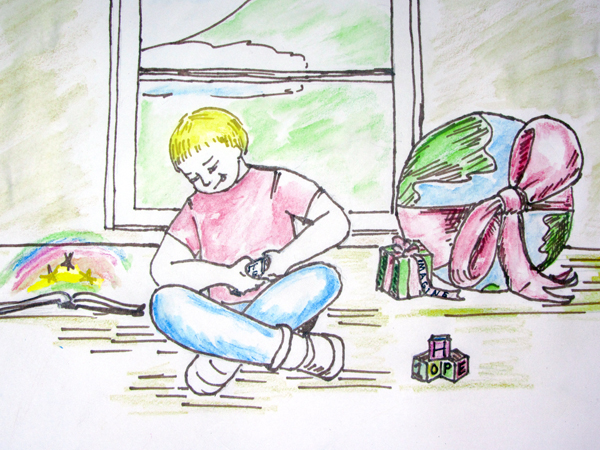
Fruitcake
I used to think I’d been really short-changed by Mother Nature. Born into a family of smart, attractive women, I must have been day-dreaming the day she was passing out her gifts because, while she was giving my sister brains, beauty, and personality, the only gift I got seemed to be a set of smarts associated exclusively with my derriere. My parents, however, were much more egalitarian about the gifts they gave us. They made sure we left home equipped with at least a modest command of manners and survival skills. And, in the fourth grade, my mom gave me the gift of writing.
Our family was living in Peru for a few months while my dad was working with a pediatric clinic there, and, contrary to what we had hoped, we were not going to spend the Peruvian summer goofing off. A former high-school english teacher and future history professor, my mom was adamant that she would keep us caught up with our classes at home.
My sister and I knew she was getting the lesson plans and materials from our teachers before we left, but somewhere in the corner of my mind I still nurtured the idea that I would be able to weasel out of any serious studying for the next few months. After all, my mom was – literally – (and is) the nicest person you will ever meet. I rarely hear her raise her voice, and, even in what should be a heated confrontation, she manages to keep a civil tone in her voice. It was not until we were going over my abysmal report card from the previous term that I realized how badly I had underestimated her resolve.
One gift I did get from Mother Nature was an olympic-calibur ability to daydream through even the most interesting class, and, at the time, I didn’t think fourth grade was too interesting to begin with. Determined to put a stop to my academic apathy, Mom decided we would work on the research projects together. The school had decided on the themes, but together (kind of) we settled on at least one book report, with mom promising I would learn to write at least one well. She kept her promise.
Under her gentle but unyielding tutelage, I learned how to write outlines and how to write a draft. I learned the word diction, and I learned how to take criticism without breaking down in tears (tried it at least once, still had to study). Almost completely my will, she gave me her literary gifts, and, at the time, I showed as much gratitude as if I’d received a fruitcake for Christmas.
When we got back to the states, Mom’s determination had put me and my sister ahead of our classes in her two favorite subjects. The experience set the tone for the next few years, and she continued to critique our papers. There were fewer and fewer tears, and, by the time I got to high school, I had acquired a taste for fruitcake (which, as some of my old classmates may remember was pretty evident in at least one thing I wrote for our entertainment).
We all know the joke about fruitcakes – that there’s really only one that’s been eternally re-gifted from one family to another over the years/decades. Right now I’m wrestling with the challenge of re-gifting a love of writing to my oldest son, and he’s just as excited about it as I was when I was in his shoes. I spend a lot of time wondering how my mom made it interesting, even when she was making it hard. And, on those nights when I’m pushing him to rewrite and revise something, I realize there was a lot more than just a love of writing that was mixed into that fruitcake. There was love, of course, and there was perseverance and creativity. And from her aspirations for us, I have found inspiration. It is a gift I hope to pass on.
Share this:

An Un-Random Act
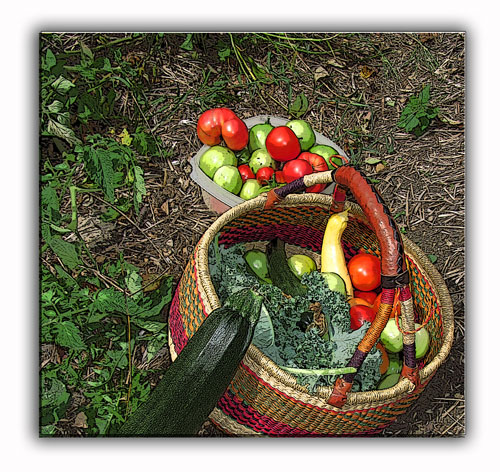
From the first year we were married, living in a basement apartment in Boston whose only highlight was the extremely shady but private 12 x 12 ‘yard’, I knew I needed to garden.
Once my gardening was simply a way to be outside and be near something green – something sorely missed in the city. Then it became a path to greater food independence. Still later, it became my place to experiment.
Now, even living surrounded by farmer’s markets and CSA’s, I still grow at least some of my own food and flowers each year. Sometimes I struggle to explain my addiction to others and even to myself, and, as I went out to rescue what may be the last of this year’s hot weather veggies from an impending spate of bad weather, I meditated on the question once again.
This mental meandering always takes my mind from the why’s of it all to the smell of the basil leaves in my pail and then to the the chirping of the crickets nearby. I listen to the song of the tree frogs and then travel to thoughts our toasty kitchen with a homegrown savory stew on the wood stove. I wonder what the people who worked this land a hundred or two hundred, or even four hundred years ago would have grown. I wonder how they survived without a country store three miles away and if we could if we had to.
And, finally, my travels take me to a place where I want to keep these skills, even if we may never need them to the degree we have in the past. They take me to a place where I am connected to our land and to its history, to an act of faith that something good will come from my labors each year, and to a place where I am truly mindful of my senses. And, most of all, they take me to that place where I am determined to cultivate – for as long as my body will let me – the peace that comes with the knowledge that those places do exist.
Share this:

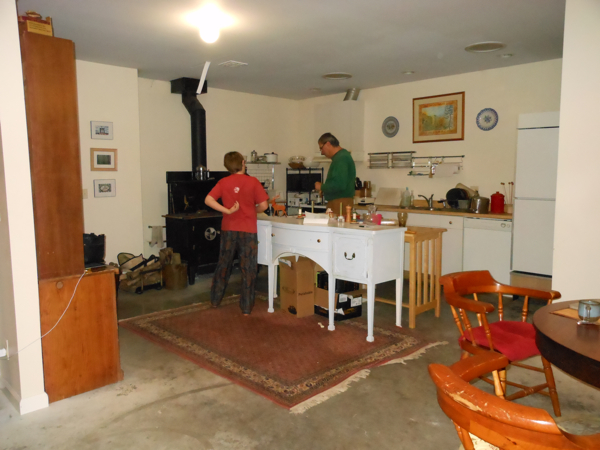
Our Cool Cave

Our Cool Cave
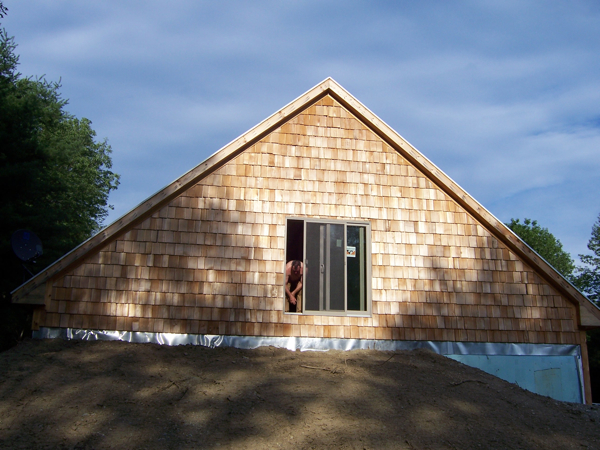
A quick tour of our house – even at its cleanest – will reveal our deep affection for the ‘Early American Garage Sale’ style of decorating. We each adopted this approach to interior design out of economic desperation years ago, and our hoarding natures served only to affirm our love affair with ‘Post-Modern Pack-Rat.’ And, while no one will ever accuse me of having flair, our embrace of all things eclectic served us well when we decided to build our current house or, as we like to call it, Our Cool Cave.
I had been googling owner-built and low/no-energy houses since a move to Germany in 2000 introduced us to new conservation concepts. Germans have experienced much higher transportation and heatings costs for years, and that has pushed them to adopt many energy-saving innovations. Some we expected to see, such as the well-known public transportation system. Others, like the numerous solar-powered buildings in my cousin’s town of Freiburg were a complete, inspiring surprise.
To my Favorites folder I added links to low- and high- tech building ideas. I added links on the block house construction so prevalent in Germany. I added links about super efficient water heaters, convection heating and cooling. But what really caught my eye were the websites featuring Earthships.
Originating in the southwest and often owner-built of recycled materials such as earth-filled tires or even soda cans, these designs employed what, at the time, we considered to be innovative but extreme (and out-of-reach) ideas for conserving heat and water. The High Thermal Mass of these buildings kept the interior temperature relatively constant, and, while our German apartment building had been built with the same idea, we realized we were just scratching the surface in terms of energy savings.
Five years later, I was sitting in the kitchen of our charming antique farmhouse looking at the not-so-charming oil bill for the coming season. It had increased almost 30%. Our electric bill was always high, despite our often-draconian conservation methods, and the high price did nothing to stave off the frequent power outages that accompanied storms, Nor’easters… the breaking of a twig five miles away….. I knew there had to be a better way – I had seen it online, and we had lived it. Moving back to Europe was not on the table, but I knew I was not going to pay another oil bill. All I had to do was convince the Big Guy that he was tired of paying oil bills, that we should build a low-energy home to get away from them, and (if possible) that it was his idea.
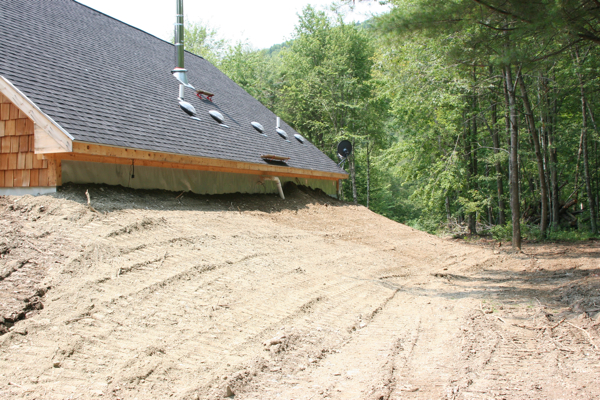
So I dug out my old Favorites folder and started trolling the Earthship sites again, becoming increasingly enamored with the earth-sheltered and underground versions. Surrounded or buried by at least 3 of dirt, these homes take advantage of both the voluminous insulation and the constant 55 degree temperature of the earth. Many are owner-built, but there are a growing number of companies that are marketing these modern sod house. Earth-sheltering became my new drug. I quietly collected a folder of clippings and waited for Mother Nature and/or politics to create my opening.
One fall afternoon after a particularly long power outage, I waltzed into my husband’s workplace with my folder and said, “We need to make a change.” I spent the next fifteen minutes building up to my pitch, pulled out a flyer from an underground home builder and waited. The printout didn’t even hit the counter between us.
“I love these houses!” Exclaimed the Big Guy. “I’ve wanted to build one of these since the seventies! Don’t you remember me telling you about them years ago?” Obviously it had not sunk in then, but it did now. I couldn’t believe it, we weren’t just on the same page, we were on the same page.
We spent the next year and a half researching and finally building the house. We gave serious thought to having a specialized builder do the design and construction, but ultimately decided to be our own contractors. Managing the design and construction of a house has ended marriages, but I think willingness to experiment helped us build a better house and not go too crazy in the process. We relied heavily on humor and the diverse sources of information we discovered as we went along.
In the end, we came up with a design that got us off of oil (we now heat with wood) and met the lifestyle demands of our growing family, abandoning formal living spaces in favor of flexibility. Extensive conversations with builders and engineers led us to bury the house on three sides only with super insulated conventional roof. Cool in summer and cozy in winter, our mostly-finished six-year-old house is the most comfortable place we’ve ever lived. The piles of earth surrounding the concrete shell insulate us from sound so well that we often aren’t aware of even violent storms unless we go out.
No design is perfect, and if we had to do it over again, we would certainly make some changes, but the one thing we would not change is our status as modern cave dwellers.
Share this:

Why a Flock Needs a Mudroom
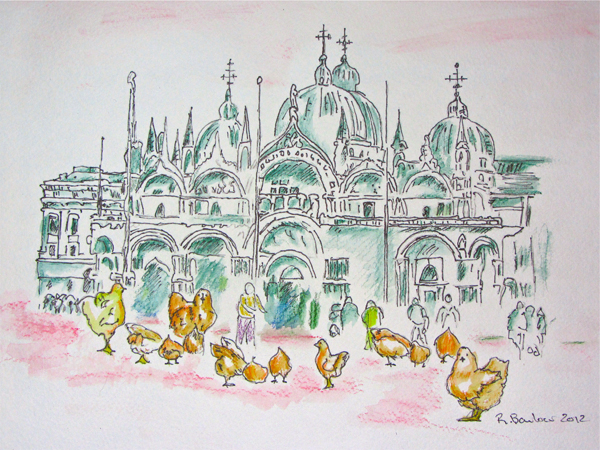
Piazza San Mudroom
One of our first – and favorite – country life endeavors was the acquisition of a flock of chickens. At the time, the backyard chicken movement was in its infancy, and most of the books we found were republished versions of guides from the 1980s, so most of our education came from trial and error and picking the brains of our more experienced neighbors.
Now, there are a lot of books out there that will tell you what you need if you want to keep chickens. You’ll need something to keep the varmints out. You’ll need a watering system. You’ll need housing and a place to keep their food from getting moldy. But the one thing they don’t tell you is that every backyard chicken owner needs a good mudroom and a healthy tolerance for messes.
Our chickens – my husband liked to call them ‘The Girls’ in his best South-Chicago accent – were truly free range. To be sure, we locked them up at night, but in the daytime, they had the run of our garden and yard, and our flock became very friendly with us. They followed me into the garden, scratching and digging and weeding. They’d follow the kids around the yard, risking death by flying baseball to enjoy their company. And, if we left the front door open, they’d follow us into the house.
The first time it happened, one of The Girls had followed me in when I went to get a garden tool. One of them inside momentarily was adorable. She hopped around our cluttered entry way, exploring until I decided that we were in danger of invoking Murphy’s Law and, playing it safe, tossed her out.
Little did I know that she had discovered the bin of cracked corn we had leftover from winter feeding.The next day, I had two companions close behind me as I walked to the door. This was threatening to become a trend, so I put my foot between us and warned the family that the girls were suddenly interested in the house.
This kept on for a while, and The Girls being more persistent than we were vigilant eventually began finding their way regularly into the mudroom. The only thing that kept our house from turning into a giant chicken coop was our mudroom – our Maginot line against feathers and chicken poop. It got even crazier when winter weather rolled in making them completely dependent on the corn bin (in the summer they survived on bugs for the most part).
Now, I did draw the line at the living room door – the only chickens in the main house are in picture frames (along with the rest of our family), But, when there was 6-8 inches of fresh snow on the ground and another 4-6 inches on the way (cracked corn sinks), the mudroom/poutry bar was a really convenient way to feed the ladies. And, somehow, the new mom who had been revolted by the sight of pigeons feeding from and off of tourists in the Plaza of San Marco in Venice had morphed (in a mere five years) into a chicken lady, cooing as she fed The Girls and snapping pictures when it was her husband’s turn. No one who knows me would ever have mistaken me for a neat freak, but convenience and necessity were teaching me not to let my feathers get ruffled (sorry – I had to do it).
A couple of summers ago a fox a way into the coop and decimated our flock. Fixing the coop and restocking is fairly high up on the to-do list, but, in the interim, the mudroom has been cleared and re-cluttered several times, erasing any evidence that it was once a poultry bar. I’m still sure that a mudroom is a must-have when you have chickens, but now, even at its most cluttered state, it feels a more than a little empty without our companions, making me wonder if the mudroom needs chickens to be complete.
Share this:

The Sweet Spot
A Side Order
It was just like any other Friday night. We were planning on a dinner with the kids at our favorite diner – a babysitter wasn’t in the budget -and then a night on the couch in front of the tube. The only thing that set this Friday apart was the fact that it was our sixteenth anniversary.
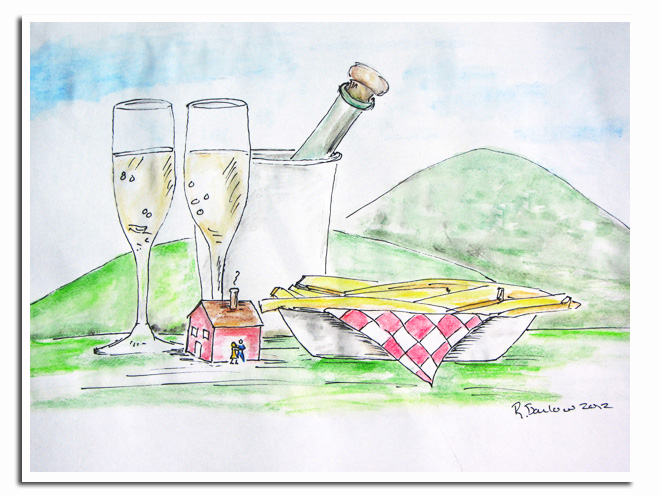
We weren’t celebrating another decade or any major milestone, but, in some ways, our run-of-the-mill family night routine made it as special as a gourmet dinner out. It was mundane, but it was a recognition that we’ve arrived at that sweet spot where we can’t remember a life before we were together or imagine any life in the future without each other (even when we hit the inevitable rough patches). And it was a reminder that happily ever after isn’t always about champagne and caviar – sometimes it comes with a side order of fries.
Share this:

A Slacker’s Guide to Going Green

Singin’ in the Rain
We found each other because we’re both a bit goofy, and that goofiness has led us all over the world. Sometimes it has led us off the deep end, or so some of our friends and family thought when we decided to build an off-grid, earth-sheltered house. In reality, it was one of the best decisions we ever made, and it has rewarded us in many unexpected ways.
When we moved to Vermont, we bought the quintessential antique farmhouse, but, after five years of paying the quintessential gargantuan wood, oil and electric bills that go along with any drafty, mouse-infested home, we decided to make a change. The stint in Germany that preceded our migration to the mountains had exposed us to new and old ideas about building with heating and electric savings in mind. We sifted through folders of clippings and evaluated any conventional and offbeat idea that popped up in the search engines.
Finally, we settled on the idea of an underground house. At the time we didn’t plan to go off-grid – it was still just a fantasy. But our site made bringing in the power more expensive than making it ourselves, and suddenly we had a new research project. Ultimately, we ended up with solar power and hot water and a backup generator. We bought the queen of wood cookstoves (my non-negotiable demand) to heat our house, food, and (in winter) our water.
We moved into the house in the fall, and, aside from having to quickly buy a much more efficient refrigerator, we noticed very few changes in our life. Like most Vermonters – we already used a clothesline 90% of the time, we already had a garden, and we already worshipped our woodstove – but we still patted ourselves on the back for being so green. The reality was we were (and are) slackers, and that was what drove most of our design and energy decisions. It still does now.
So as the Big Guy walked into the house yesterday soaking wet, wrapped in his towel and carrying a bar of soap, I was amused but hardly surprised. It was pouring out and after an afternoon fixing fences, washing off in the rain obviously seemed like a great idea to him(especially since we’re surrounded by trees and mountains and more trees), but I still couldn’t figure out exactly what had motivated it today.
“Saving water,” he announced as he sauntered across the living room, leaving sasquatch-sized puddles on the concrete floor.
Later, as we were both not volunteering to mop up the water, I tried to decide what I love most about this house – the way it fosters zany outlets for our green and/or lazy impulses or the fact that it’s in the middle of nowhere so that no one calls the cops when we indulge in them.
Share this:

Iron-Clad
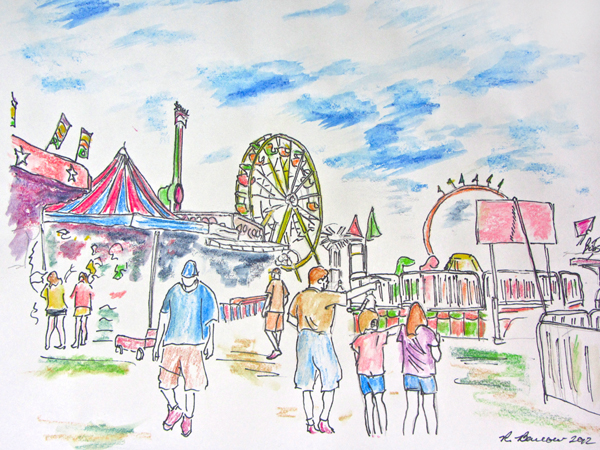
Washington County Fair, NY
I should have been putting up the 40 pounds of tomatoes sitting on the counter or cleaning or writing or weeding or cleaning (did I mention cleaning?). Instead, I was sitting on a courtesy cart on my way from the parking lot to the entrance of New York’s Washington County Fair. The little imp that sits on my left shoulder is the queen of rationalization and had already come up with a couple of great excuses for the less-wayward imp that sits on my right shoulder (I don’t have any internal angels). However, as luck would have it, our driver came up with the hum-dinger of all pretext for a day of play – one I know I’ll use again and again.
Our main reason for going was to see the 4-H exhibits. None of us have any interest in those rides that involve leaving your stomach hovering 20 feet in the air over the rest of your body. However, we all wanted to ride the ferris wheel – all of us, that is, except for Thing 2. So, as we climbed onto the courtesy cart, he became the victim of an escalating ad campaign to get all of us onboard with the idea. The lanky, slightly-older gentleman driving the cart noticed our five-year-old’s plight and took pity on him.
“Know why I don’t like ferris wheels?” He asked.
Thing2 turned his face toward my stomach (his preferred debate technique).
The driver then told us of a draconian punishment he had endured at the age of nine and at the hands of a father he never saw again. In somewhat vivid detail, he described how his parent pushed him from a precipice and how a hatred of heights sprang from that betrayal . My hands moved to cover Thing2’s ears to filter out the story, but I was too slow, and I was to be happy about that by the end of the ride.
” I work with other kids like me,” he went on. Before we had time to consider the courage it took to evolve from a cast-off to a champion of others caught in the cycle of neglect, he asked, “You know why I like working this job too?” Thing2 was now listening intently, as were we all. “I like seeing people coming here enjoying their kids. Not like the kids I work with. Not like my parents.” He pulled the cart to a stop in front of the ticket booth and smiled at Thing2 and at me and my husband.
Then, lightening the mood, he asked Thing2, “Know how cows have fun?” Thing2 shook his head, no. He grinned at all of us as we stepped out of the cart. “They go to the moo-vies.”
We groaned and the kids laughed and we waved good-bye as we trotted up to the ticket booth. Gone from my mind were the tomatoes and housework and writing and all the excuses I thought I needed to be here. In the end, the only – the iron-clad – excuse that we needed or will ever need was that we wanted to enjoy our kids while we’re lucky enough to be able to do so.

 Picking My Battles