Get Back

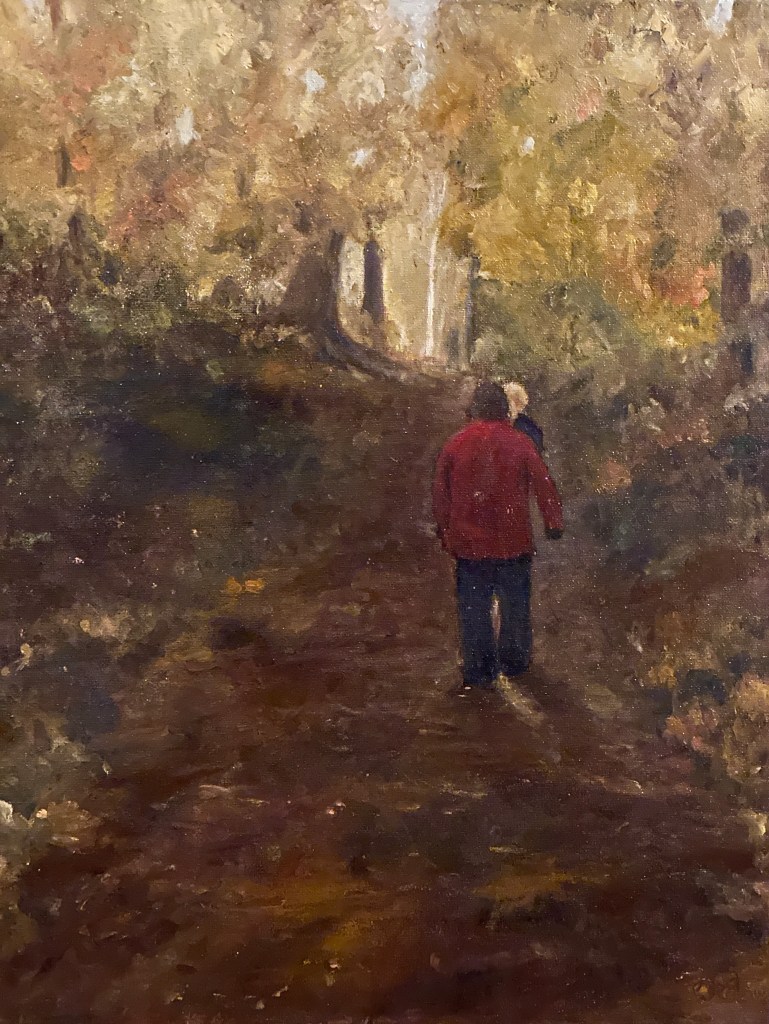
Thing1’s first visit to the Bluff

Sometimes, to get the important parts of your life back, you need to get back to the people and places that have mattered most to you.

Rain on the Way

You need to forget about doing things the right way or making anything “good” and just embrace being in the moment, so that in those moments with the people and places that matter, peace will finally find you again.

Painting and Pondering

For ages I’ve wrestled with the ethics of painting with a medium that requires the purchase of little plastic tubes of pigment that will ultimately end up in a landfill. My neurodivergent brain perseverates on the idea that all these creations will end up at a garage sale, and then the landfill. Does the world really need more pretty pictures of landscapes?

I know when we move to a city next year, I will paint the things that I find beautiful there and I wonder again, does the world need more pretty pictures?

As election season gets uglier, however, I realize the answer to that is a resounding yes!

I paint the landscape Vermont, because it is increasingly developed and less wild, and I want to share a beauty that I think is worth protecting. When we go to the city I’m always drawn to parks, filled with people from different walks of life, and I don’t want to get better at painting people. That expression of community is also rare and precious.

As I was standing in a field, trying to remember how to paint (not quite there yet), I was able to remember exactly why I need to meet these things. When I’m standing there, I feel like the little mermaid if she was middle aged and fat and still wanting to be part of those precious parts of the world.

So there won’t be anything profound or deep. There’ll just be more pretty pictures (I hope), but I think it’s actually maybe, just maybe what we do need.

Discover, Create, Repeat

When you go about rediscovering the world in middle age, you don’t feel like an adult — confident about what you know and comfortable with the things you don’t know. Suddenly, you know nothing.

I have joked to my husband that, for the last two weeks, I’ve felt a bit like Milton Wadams from Office Space, shuffling and mumbling as I reprocess each sensation and landscape — gravel under the feet, the plaintive sound of an orange cat needing to be petted just so, dishes arriving at the dentist.

Now, I’m actually learning to embrace the shuffling and robotic processing of sensory input. Rather than being a malcontented, midlife crisis, I’m trying to experience the world as if I were a child again.

My only source of malcontent has been how difficult painting has become difficult this week. The sensors still seem disconnected from output. Partly out of desperation (knowing that non-writing/drawing artist is a monster courting disaster) my post-labyrinthectomy journey of discovery seems to be bringing me back to my blog – my original writing and drawing diary.

Now, as I am watching every little detail around me, I mentally record the mundane and magical moments around our yard like a robot, searching, not for artificial intelligence, but authentic interaction with the world. This voyage of discovery will undoubtedly reroute my journey of creation. 

When I was first diagnosed with Ménière’s disease three years ago, I was told that it was a disability that automatically disqualified you from multiple professions. Two years ago, I was told to stop using stairs taking public transportation by myself because likely and actual unpredictable “drop attacks.” I was told the disease would end when I lost my hearing in the affected air. 

Last week, when I give up the hearing to prevent any more false, it would’ve been easy to see the change as a loss, as acquiring more disability. 

Instead, the opposite is happening. It may take some time to be able to drive again, and the shuffling will probably persist for a while. That’s OK because the shuffling is part of rediscovery, and that will lead to a whole new chapter of creativity.

Boundaries

Whither We Wander

One of the weirdest things about Ménière’s disease is that when the weather, and the air pressure change, you can feel it. I know it’s not just me, because when I visit chat rooms of other people with this wacko disease, I see other people reporting the same exact symptoms, that, in any other forum would, be cause for being involuntarily committed.

Right now the wind outside is pounding, and, even though we’re in a house with walls of 10 inch concrete, and 3 feet of dirt surrounding it, I am rocking. My brain literally thinks we are wrapped in a hammock being tossed back-and-forth even though I am literally lying on my bed holding on the mattress, so I don’t fall off.

Are used to love blustery days, especially at the beach, standing at the top of a bluff, feeling the wind and spray blast against my skin. These days, however, it seems as if mother nature isn’t respecting my boundaries.

But the wind howling and bringing down trees outside have to be her way of reminding that there are some things you just can’t control.

The Not So Bad

Most of the time I hate Ménière’s disease. When you’re not being violently rocked as you try to get to sleep at night, you are hugging the floor trying to get the world to stop looking like a ceiling fan that gets stuck on a quarter turn, and then resets itself before Turning again. There are perverse times, however, like right now, When the salts and crystals in my inner ear, create the sensation of being on a an inflatable raft on Lake Michigan on a gentle wave kind of day.

In two weeks. I’m going into the hospital to have a procedure that will probably cost a good amount of hearing in the affected ear in exchange for getting my life back. The trade is going to make it easier to drive and work with some stability. Even though I won’t miss the vertigo and the falls, I’m trying to commit tonight’s gentle wave sensation to memory. It’s a lesson that even the things that make life really hard sometimes, can bring an unexpected smile to your face.

Spring Cleaning

Clearing

I’d read the same paragraph about neuroplasticity three times and been unable to remember what the major point when I made the decision to kill off a part of myself. I did it with a tiny little pill. It will be a drawn out death, but it’s not a murder. It’s self-defense.

For as long as I can remember, a highly structured, complex fantasy world has occupied a good portion of my brain. Psychiatry journals tell me I use it to cope with anxiety and PTSD that I should be old and experienced enough to manage without a tiny little pill. But, as I annotated another article on the miracles and vulnerabilities of the human brain, I realized that by letting my cranial amusement park stay open, I’m a hypocrite.

My still embryonic career as a special educator has focused on children with intensive needs, specifically children with behavioral and mental health issues. I’ve been where many of them are. They’re my tribe. But the most important part of my job is to helping them be present in the world — something I’ve lacked the courage to do consistently. To be present for them, I know I have to be present for myself.

I’ve had the the pills (and several other similar prescriptions) in my pill drawer for a few weeks now. I’ve told myself I’m holding off to make sure the side effects don’t get in the way of work, but, after reading a paragraph three times because I keep returning to the fantasy world, I realized things are already getting in the way of the first truly meaningful professional experiences of my life. The fantasy world even gets in the way of making art.

There are things that get in the way of work and life that you can’t control like a chronic illness. I’m starting to accept mine, albeit ungracefully. But there are the things that you can control, and all of that control starts with being honest with yourself. Honest that mania and depression do not improve your creativity; they keep you from picking up the brush. They are not the inevitable byproduct of discovering a very real disability; they are the excuse to wallow in the fantasy world.

Killing that world is scary. It means cutting off and escape from reality. It’s even scarier than admitting that, in your fifties, you have the fantasy world in the first place. But, today, the realization that it, and not any disability, could keep me from doing the things I desperately want to do, meant that it, like a tumor, had to be irradiated.

New Rule

The alarm is set for 8 o’clock. It’s just past midnight, and I am staring at the ceiling, my eyes glued wide open. For once, neither I nor the ceiling are spinning, but nobody has managed to get the gremlins in my head to stand down.

The last few weeks have been defined by bouts of Ménière’s-related vertigo that have forced me to use a wheelchair to keep from falling down at work and to depend on other people to get me from point a to point B. At home this translates into far too much time spent on the couch watching reruns while mindlessly doom scrolling through text and images that I’m far too nauseous to absorb beyond a headline here or there.

When the fog clears, I try to paint – especially when the gremlin are keeping sleep away. Sitting and scrolling are becoming far too habitual, however.

This morning – it’s morning now –– I’m out of thinner for my paint. I’m desperate so I get up and fill the tub, grab the first book I see in my office and sink into the bubbles.

It’s not a novel. It’s a book about the history of English which turns out to be great. I expect to be engaged, entertained, and sooth, when I read fiction, but I’m surprised how relaxing it is to learn something new at two in the morning. I’m having the age old problem of not being able to put the book down, but it’s a different sensation from scrolling through toxic pages of social media posts.

Scrolling is turns my body into a clenched fist.

Each turned page, however, slows my heart rate. Each new factoid relaxes another muscle.

The book may keep me up all night, but I’m not worried about being worn out in the morning. The clarity that comes only from calm has helped me make a new rule. The next time anxiety tempts me to pick up the phone and scroll, I’ll grab a book instead.

Navigating by Stars

When Thing1 was diagnosed with ulcerative colitis six years ago, his doctor told us, “This is a permanent diagnosis.”

We thought we understood what that meant, but even after a year of unsuccessful treatment and the discovery that he would have to have surgery — not to cure but to manage his illness – we all had trouble wrapping our heads around the idea the concept of what a chronic illness really meant. Four years later, then one has changed his diet, his lifestyle. He’s learned to make his own appointments and monitor his own prescriptions, We think we understand what chronic means for him, but I don’t think I ever really got it until last Saturday.

For six days before, my Menieres had been remarkably inactive. I was still taking daily medication, still told myself that most of the “cure“ was due to the multiple injections in my ear. But for the last five or six days, I had so little vertigo that, the last Tuesday in February, I drove for the first time since just after Thanksgiving. I drove again on Wednesday , and then on Thursday. This was it. I was cured. I could plan for the next year of school at a district that requires a two hour daily commute. We can think about a vacation with a lot of walking.

And then a few days ago it happened, and I started to understand what Thing1 figured out the minute he learned that his UC wasn’t getting better and that he wouldn’t be going to college next week, that he would be dealing with it for a long time.

Saturday, I was watching the clouds roll in for another storm, feeling my ears pop and crack with the change in barometric pressure. I’d read other people with Menieres say the same thing and knew an “attack” was building. As the Big Guy and I made plans to go to breakfast while Thing2 was at his weekend job, I reluctantly handed him the keys, not knowing when I’ll be able to take them back again.

There’s very little good in what’s been happening, as far as I’m concerned, but the few only bright spots have illuminated the my way forward. That morning, as the world began to spin and rock again, I tried to focus on my memories of Thing1’s stalwart examples of acceptance and determination for the past six years. Those memories and the reminder that chronic often means permanent suddenly helped me truly understand my oldest son who, not for the first time, has often been my Northstar in learning how to navigate life challenges.

Tumbled

I’m starting to get used to the vertigo now. It’s been going on for all day for the last month, and it’s hard to remember a time when the world hasn’t seemed like I’m watching it from inside a dryer.

Chronic illness is nothing new around our house, and Thing1 set a really high bar for accepting fate with graceful determination when he got his ulcerative colitis diagnosis a few years ago. I watched his experience, and, I know that, no matter how you handle it, a chronic illness means chronic, not curable.

Last Tuesday I had an injection of steroid into my inner ear that hopefully well control the symptoms for a few months at a time, putting the disease into remission. Forty-eight hours later, there were breaks in the tumbling until I torpedoed my success with too much salt which led to a hangover on Thursday. When the hangover began to recede, my first sensation was exhaustion. After a 20 minute nap, however, I felt like a towel that had been pulled out of the dryer and hung on the line, fluttering with my second or third wind.

Organically Grown

Somedays the wind is howling around the mountains. Other days, the sun is pointing out every new bud in the forest. Even when it’s grey and the back section of our trail is more pond than path, though, at four o’ clock, at least one kid and one adult will ask if we’re all ready to walk. Our walks have attained the ritual sacredness of communion, and, even though they are peppered with swear words when the boys argue about whose turn it is to chase the frisbee into the increasingly green rosy-bush, there is serious communing going on.

The walk around the house is about a tenth of a mile. Thing1 has a goal of getting his parents to do 30 laps walking and then running. I’m treating it as physical therapy for my ankle and, on days when my lungs allow it, have managed 10 laps with a few passes through the garden to talk to the peas and carrots. The Big Guy, waiting for a knee replacement, is less focused on the number of laps than on just walking with the boys. 

The kids will do two laps for each of ours, deliberately tossing the frisbee into the woods or at each other’s heads. Thing1 and the Big Guy will talk car repairs. Thing2 will talk music and life.

We don’t see each other for most of the rest of the day. Thing1 is finishing up classes from college online until late at night. Thing2 has class in the morning and then has creative projects. I write and study, and the Big Guy reads. There’s an implicit understanding that, while we are locking down, we need to have our physical and mental separate corners.

Vermont’s governor is slowly relaxing restrictions that have helped keep our infection rate down, but, with high-risk people in the home, our family won’t relax the current routine until we see evidence of a prolonged absence of a second or third wave of infections. As the rest of the state returns to normal, I’m grateful for these organically grown rituals that keep us close but not constricted, knowing they’re about to become even more important.

Drawing Lots

Pneumonia benched me well before Covid-19 invaded neighboring New York State, but my son’s severely compromised immune function was already forcing considerations about whether and how to keep working at the residential school where I teach.

Our school immediately implemented Herculean measures to reduce the likelihood of infection. The experiences of other assisted living communities across the nation, however, suggested that any infection, once introduced, would spread rapidly. I love my school kids, but knew working during the pandemic might mean living away from my family. When my body turned on me, I was almost grateful to surrender the decision and took a leave of absence as our family settled into the stay home directives that, while not all that new for most Vermonters, felt like a different normal.

When I started considering family safety, the virus was sweeping through cruise ships. There were a handful infections in Washington state, and the media zeitgeist was proclaiming that the virus “only” endangered the elderly and people with chronic illnesses (about 157 million people in the US), as if that made it more tolerable.

One night early in March, however, I caught an interview with Yale physician, Nicholas Christakis, predicting the trajectory the infection would soon take. Identifying schools as disease vectors (as any parent or teacher weathering flu and strep season can attest), he advocated nationwide closures. “Flatten the Curve“ hadn’t been coined, but he was articulating the strategy: slow the spread, reduce the load on the healthcare system, and improve the odds.

As March and the pandemic progressed, Christakis seemed like Cassandra delivering disturbingly accurate warnings, heeded only when case numbers and fatalities began to skyrocket.

I remember marveling at extraordinary examples of solidarity by people from all walks of life filling my Facebook feed when Americans did adopt the social distancing guidelines already in place in Europe. There were some doubting the seriousness of the disease or disregarding how their continued mobility might endanger others, but videos of people making masks, entertaining each other, organizing school services and lunches for kids and families were brief testaments that we were all at least trying to be in this together.

Then the economy, already wobbling under volatile oil futures and markets, imploded. Poorly maintained government safety nets struggled to expand and accommodate millions of newly unemployed people.  Suddenly the stay home directives were not just about flattening an abstract curve, they were about individual rights, paychecks, and haircuts.

I don’t have much sympathy for people screaming for haircuts, but at least 40% of adults in the United States don’t have $400 on hand to cover an emergency. That means a lost paycheck could easily translate to a lost roof or food. In regions that have not yet seen spikes in the numbers, the prevention can easily seem worse than the disease.

I had just started programming in 1996 when I first saw a program crash because an end-user had tried to enter the date ‘2001’ in a two-digit year field. We fixed that particular issue pretty quickly, but as we went through our other programs, we realized how many applications were vulnerable. Y2K work wasn’t just bread and butter for the next few years, it was steak and caviar.

That New Year’s Eve, I brought home a laptop to login to work and monitor for any SNAFUs. As midnight rolled around, I wondered if many programs would fail. Would the “major” systems around the world make the jump successfully?

The next morning, there had been a few hiccups but no apocalypse. Newscasters seemed almost disappointed that more things hadn’t gone wrong, glossing over the fact that the millions of programmers who had been updating systems for the previous three or four years had made that possible.

Right now, people are being asked to accept hardships to make sure that as much of our worrying as possible is for ‘nothing’.  Some people, even offering themselves as sacrifices, are willing to play the lottery and advocate for reopening the country. With one journal, however, suggesting that school closures alone prevent “only” 2-4% of Covid-19 related fatalities (2000-10,000 lives depending on projections) and new reports of hospitalizations and fatalities among younger, healthier people, reopening the “country” is a lottery that will trade lives for paychecks.

But too many missed paychecks can also cost lives. 

Some (including me) would argue in favor of securing the social and digital safety nets to enable as many people as possible to stay home longer and reduce illness and contagion. People advocating the alternative, however, do have valid concerns. Safety nets are expensive. Any vaccine could be at least a year away. There’s no confirmation, yet, that surviving the disease confirms permanent immunity, meaning that this could be a question of thinning the herd rather than building herd immunity. Stay home directives could be simply delaying the inevitable.

Less than a century ago “The Lottery”, by Shirley Jackson, depicted a modern version of a “brutal ancient rite” taking place in some version of Bennington, Vermont. Townspeople drew lots to determine who would be sacrificed by stoning to ensure a good harvest. The New Yorker and Jackson received mountains of complaints and abuse from shocked readers who could not countenance the idea of even fictional human sacrifice in a modern setting.

We aren’t choosing lots or stoning people to death, but in the end, we are being asked not just what we personally are willing to surrender for the economy or a flatter curve. We are being asked who we are willing to sacrifice to achieve either goal. How many and which people are disposable?

On our very micro level, I know I would give my life to keep my kids safe and fed. I also know it’s easier to be a martyr than a problem solver. At some point, the pandemic and the economy will force us to ask the tougher question of how to balance Thing1’s health (and life) against my need to work, against Thing2’s right to go to school and grow. When do we “reopen”? We’ll find some answers in logistics. Other answers will require making ethical choices far more difficult than drawing lots.

Don’t Go There

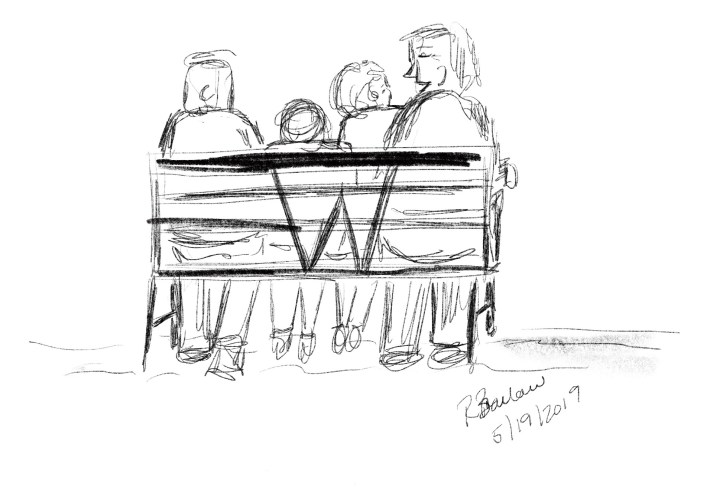
Still on the Group W Bench together

It started with a writing prompt a few days ago. Write a scene with no more than four characters that happens in one room. It was a good assignment, but at first it took me to some very dark places before I remember I was in control of this story. I don’t have to go there.

I’ve tried to treat the last month of Sparkling (and, at our house, often smudged) Solitude as a gift of time, but, as many people are finding, worrying about loved ones, finances, and the world of suffering happening beyond our driveway more than dulls the sparkle. As I wrote, I realized that, while my own respiratory issues have kept me off the frontlines but not terribly fearful, Thing1’s nearly fatal history with a chronic illness that makes him particularly vulnerable has caused more anxiety than I like to admit.

My prompt response grew into a story about a family cursed with endless time and a dark choice that might save their firstborn. The scene grew out the worst night of Thing1’s illness, but, in the story, the husband and wife debating their children’s fate begin to fall apart, and I couldn’t figure out how to put them back together. I had written myself into a corner, but, as I took a break to finish cleaning the pantry, I remembered that during that seemingly endless night, the Big Guy and I had not fallen apart.

We had pulled together. 

We may have squabbled briefly about how fast the ambulance would arrive in a blizzard or if the emergency room would do anything we weren’t already doing or if we could even get there. We had nothing but bad options as our firstborn faded on the couch. In the end we did the only thing we could do. Pulling ourselves together as a team, we decided everything and every phone number until there was nothing else to try and Thing1 started to improve. 

That night wasn’t a gift. Thing1’s illness hasn’t been a blessing in disguise. Those challenges were crucibles so hot we sometimes felt our resolve begin to melt, but when that heat abated, hope solidified around our family, forging an infinitely stronger bond. 

So now I’m back to my made-up husband and wife, still at a terrible crossroads with endless time and a horrible illness and choice in front of them. There is a temptation — for the sake of art – to finish tearing them apart. There is the option to treat the endless time and choice as a curse. 

But I don’t want to go there.