Winter Heat

Sometimes to help someone, you need to disconnect just enough from your empathy to keep the other person from the fog instead of marching into it holding their hand. I’ve had a few such cases at work lately. I can recognize my own traumas in the person I’m helping, but to use the lessons of experience and education, had to resist the temptation of wading into memories.  

One of the pitfalls of that professional detachment is that it is sometimes hard to reconnect with other parts of life.

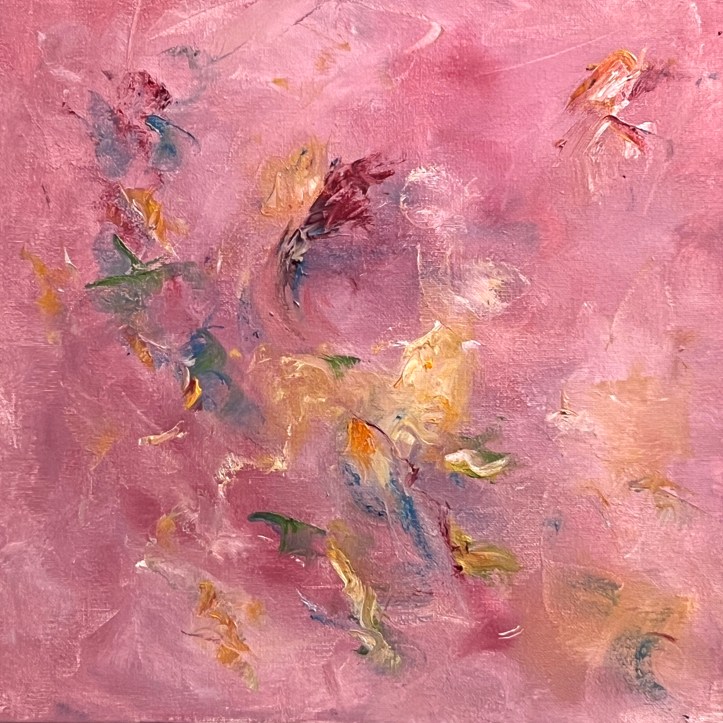
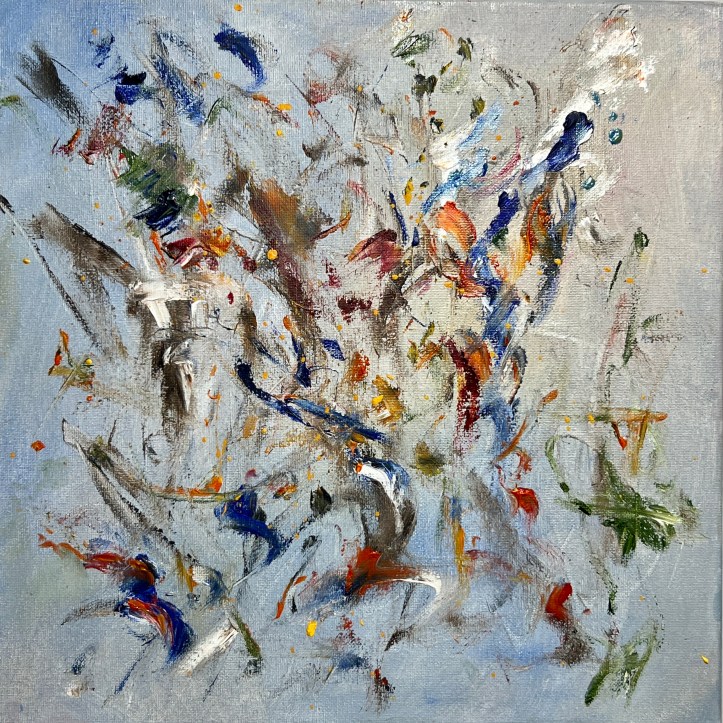
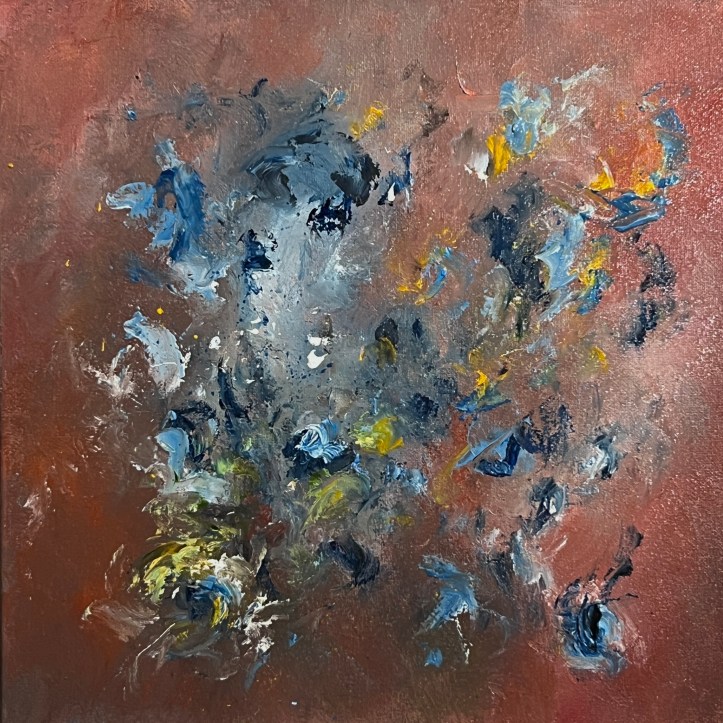
Painting is usually my lifeline, but the latest sessions felt as flat as the rest of my day. I’ve recently moved into abstraction, channeling the emotions inspired by our local mountains and the storms that move through them, and the emotion wasn’t there. 

I tried faking the emotion. Then I tried painting the flatness. 

Finally I decided to fight the flatness and get out of the studio for a day and go to the fields and woods.

I hadn’t been plein air painting since summer, and I rarely paint outside in the winter. Sometimes, I paint in the car with watercolors, but last Saturday, I knew I needed the kiss of the cold and wind to bring my whole brain to life.

It was bitter cold when I parked the car by my favorite field. I had my fingerless mittens and layers of shawl and scarf, and, after finding the right way to position my easel by the car door so that the wind wouldn’t blow things over and wick the heat from my body, I queued up a new playlist of mostly melancholy music to match my mood.

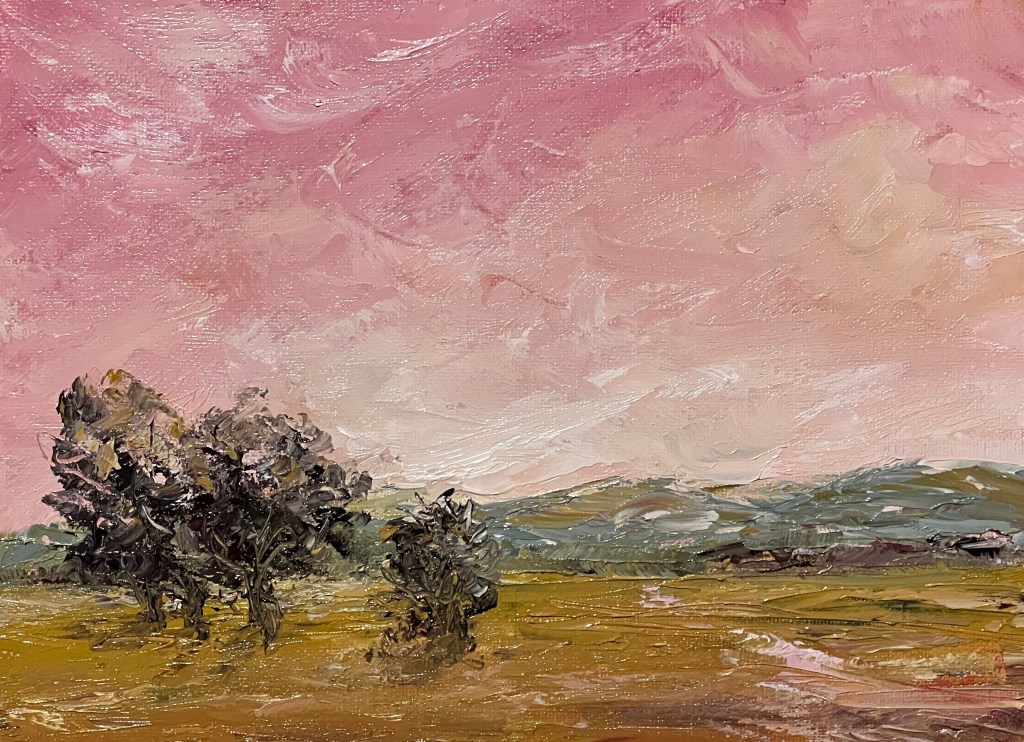
 I was keen to get the racing clouds as they brushed the tops of the mountains with a new dusting of snow. I could feel my fingertips freezing, but there was a glow of life in the midst of this winter scape. I could hear ice cracking on the nearby Battenkill as the sun briefly emerged, and some creature, disturbed my presence, rustled nearby, invading my iPod playlist with their own music.

For the first time in days I was fully awake, intensely aware of every emotion, completely at peace, and seeing the answers to a question that had been plaguing me for months: Why do I need to paint nature?

Is there a point to painting nature when the world is in chaos? Aren’t there more important subjects? Why do I need nature in order to paint?

The answers had happened as winter’s soundtrack and sights and my moving brush reconnected with the same emotions that make me want to help and hope for a world at peace in the first place. 

Incubation

I used to think about December as the beginning of hibernation. Creative output always seems to slow down as the days get shorter, and work seems far more intrusive than it does in the crackling light of autumn.

For last last few weeks my output has followed the same trend. It took me a while to recognize the pattern because I initially blamed the slowdown the Ménière’s disease that’s been with me in earnest for a year now. Yesterday, though, as I drove down the mountain and had to stop and catch my breath as fast moving clouds dusted with powdered sugar the top of a mountain across the river, I realized that this time of year is not solely about hibernating.

To catch that moment, you would’ve had to be in the exact spot at the exact time with me. The peak of the mountain is almost hidden by two others that “overlap“ each other in the view that is only seen when coming down the road from our remote town to a “main“ route. The moment sparked attempts to repeats – something that shouldn’t be too difficult in Southwestern vermont in the winter – but it was the only one that day. The moment and the search germinated hours of wonder and reading and discovery.

What do I want to capture when I paint or draw? Moments of breathlessness? Revelations of the grit that lies at the foot of these mountains? Or appreciation of one the few places humans haven’t tamed?

Tonight will be occupied with the work of work, but in the back of my brain, the next painting session is germinating. It occurred to me that every racing thought, every quiet space that arrives with the dark of winter is not about hibernating through depression. Instead that darkness may just be the needed incubation for what will come next.

Connecting to Inspiration

Last Dance, 14″ x 14″, Oil on Canvas, Click Here if you would like this painting to live on your wall.

Several days into break, I was still having trouble mentally disconnecting from work and reconnecting with family and creative life. Our family had chosen to skip the bacchanalia of presents under the tree, filling each others’ stockings with small items instead. We had all enjoyed shifting focus away from obsessive shopping, but, even as we enjoyed a low-key day and prepared for a lovely family meal in Columbus, Ohio, I was in limbo.

But my present was about to arrive.

My parents had invited friends — a professor and an artist – to join us for Christmas dinner. We had known of each other for years, and the two sets of strangers were friends by the time coats were hung. The professor chatted with the rest of the family in the kitchen, while the artist and I brought hors d’oeuvres over to the living room.

The artist is also a professor, and, through my parents, knew that I painted and drew. We had barely traded cheese and crackers before she asked about my work. I had seen some of her work and, knowing she was a serious and classically-trained artist, was a bit nervous showing photos of some of my work. Like most of the committed artists I’ve known, however, she was genuinely interested in seeing others’ work.

“I’m getting away from landscapes,” I said as she scrolled through images of mountains and trees and then through abstract images. I explained a desire to make art that was more than decorative. “I connect with nature when I paint them in real life, but it still inspires the abstract,” I told her.

“I love landscapes,” she said. “I don’t paint them very much.” She told me about her work painting portraits before teaching and creating more abstract pieces. We talked more about creating work with meaning, and then she said, “I like nature, but I don’t really connect with it. It doesn’t inspire me.”

She told me about her recent work painting flowers using a more academic approach and how her search for castoffs from grocery florists had added a new facet to her project. As she talked about mountains of plastic and dying flowers that were thrown away each week, it occurred to me that her project was as much an investigation and revelation as it was the result of inspiration.

My brain was suddenly churning, and, for the first time in weeks, it was from enthusiasm rather than apprehension. Dinner preparations and the gathering of other guests in the living room were about to redirect the conversation, and we dug in deeper for a last few intimate moments of art talk. We talked about giants of art like William and Elaine de Kooning, Pollack and Krasner, who had found inspiration but also frustration in nature, and I began to think of how much of art emanated not from waiting for an impulse from something beautiful but from seeking and investigating.

The Big Guy and Thing1 and 2 and I continued talking about the ways a creative spark is fanned as we drove back to our hotel after dinner. We were still talking about it when we drove home from Ohio a few days later.

As we plodded through miles of shopping malls to get from our hotel to the highway, I realized how difficult it might be to pack up a plein air kit and connect with the natural world there. In a landscape of strip malls, an artist has to create their own vision.

Years of being surrounded by mountains and woods have made made connecting with inspiration easy for me, and I wondered if it had made me lazy as well. Waiting for it to hit, rather than seeking out revelation also made it easier for anxiety to settle in where creativity should have been raging during the downtime.

My mom’s friend had inadvertently given me the best Christmas gift any artist could give another. She had opened a window to a new way to connect with creativity.

New Rule

The alarm is set for 8 o’clock. It’s just past midnight, and I am staring at the ceiling, my eyes glued wide open. For once, neither I nor the ceiling are spinning, but nobody has managed to get the gremlins in my head to stand down.

The last few weeks have been defined by bouts of Ménière’s-related vertigo that have forced me to use a wheelchair to keep from falling down at work and to depend on other people to get me from point a to point B. At home this translates into far too much time spent on the couch watching reruns while mindlessly doom scrolling through text and images that I’m far too nauseous to absorb beyond a headline here or there.

When the fog clears, I try to paint – especially when the gremlin are keeping sleep away. Sitting and scrolling are becoming far too habitual, however.

This morning – it’s morning now –– I’m out of thinner for my paint. I’m desperate so I get up and fill the tub, grab the first book I see in my office and sink into the bubbles.

It’s not a novel. It’s a book about the history of English which turns out to be great. I expect to be engaged, entertained, and sooth, when I read fiction, but I’m surprised how relaxing it is to learn something new at two in the morning. I’m having the age old problem of not being able to put the book down, but it’s a different sensation from scrolling through toxic pages of social media posts.

Scrolling is turns my body into a clenched fist.

Each turned page, however, slows my heart rate. Each new factoid relaxes another muscle.

The book may keep me up all night, but I’m not worried about being worn out in the morning. The clarity that comes only from calm has helped me make a new rule. The next time anxiety tempts me to pick up the phone and scroll, I’ll grab a book instead.

Discovery

In the months since we visited the Turner exhibit at the Boston MFA, my art practice has undergone a revolution.

Turner’s sketchbooks and studies in watercolor and oil pointed the way to constant, blissfully imperfect practice. Another exhibit and then a new mentor confirmed that, even in a modern era when we are saturated with expression in all forms, for the artist, practice still makes progress.

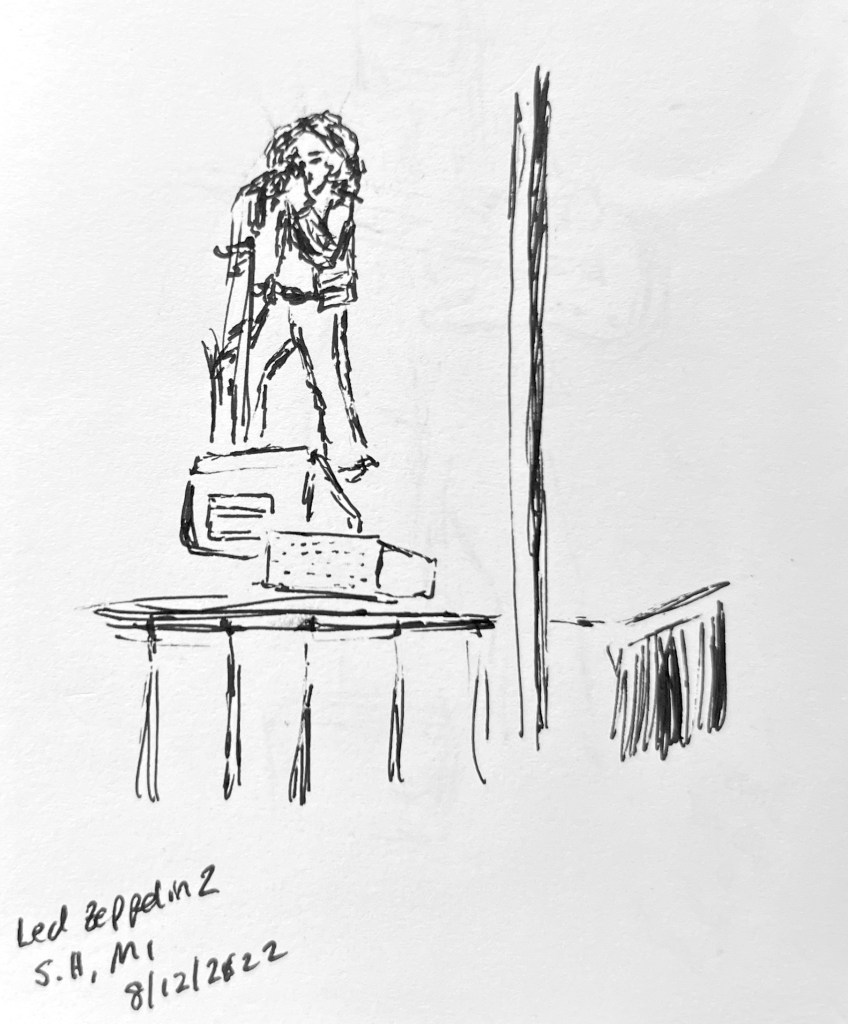
The result has been nonstop but also the transformation of my sketchbook from the collection of drawing exercises to a journal of my life and our summer role in 1-2 minute sketches.

#LedZeppelin2 live

The pages are filled with concerts with family, swimming kids, and views of America seen at 70 miles an hour. In the drawings connect me with people and events in a ways that photos simply can’t because they demand that the drawer be fully present. 

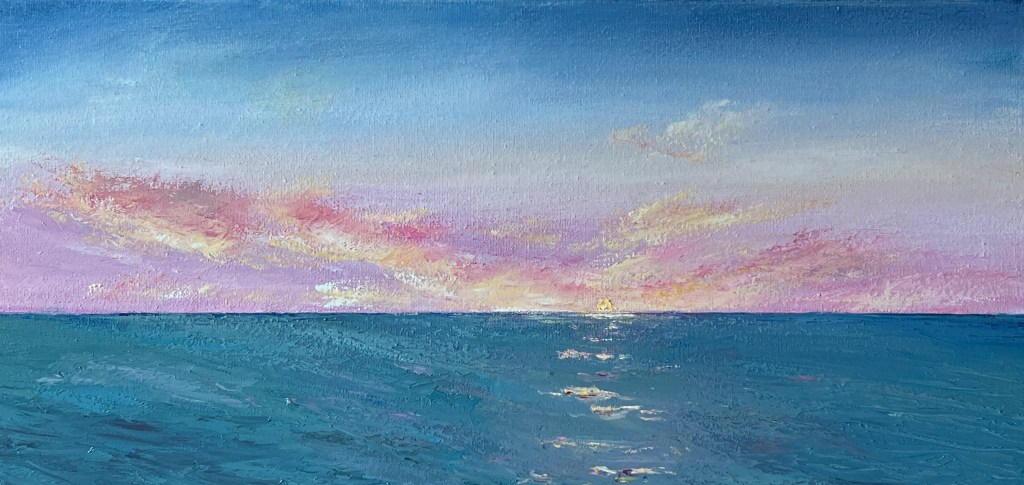
Sometimes drawings find their way onto canvas, and I am discovering that being present for an event like a sunset burns the colors more accurately into my brain than simply recording them through an electronic rectangle that often gets it wrong.

Sunsets

There are times when, wanting to stay connected to my family, I’ve ignore the inch to retreat to my studio to work. This summer of discovery, however, has made clear that making the time to practice — pursuing progress at every opportunity- only makes the connections with life stronger.

Where Paintings Go to Die

I knew the lighthouse would be the most difficult thing to paint. I usually take only palette knives when I do plein air, and my hand has been shaking for the last few months because of my Ménière’s.

Still, the beach and dune and lighthouse in Southhaven Michigan are almost obligatory subjects, and I knew, if I didn’t at least attempt to paint them, I would have them nagging at me for the rest of the week as I tried to capture other scenes around southwestern Michigan. So I got out of the house early in the morning and set up my easel in a shady spot with a good vantage point, determined not to let any inner critics make the scene more challenging than it would be.

I like painting mountains and fields. I know them, and I can focus on the feeling and not the fundamentals. Painting the lake should be easy (I’ve been here every year since I was a fetus). I haven’t, however, practiced enough with that spot where the water meets the sand on a calm day or the crash of the waves. Seeing was going to be a challenge without perfectionism getting in the way.

The sky and horizon went in pretty easily. I’d done a rough sketch of where the lighthouse and trees in the foreground should go. Even the blues of the lake seemed to be dropping in pretty easily.

Then came the time to draw the rigid lines of the pier that connects the lighthouse to the shore. I’d loaded my palette knife with dark gray to scratch a thin dark line across the middle of the lake when a woman asked if she could take a peek. I always say yes to be friendly even if I’m not happy with the work and don’t want someone to see it. We chatted about where we were from and our connections to South Haven.

“I’ve always wanted to paint,“ she said, “but I’m not really an artist.“

“Everyone’s an artist,“ I said. “You should paint it.“

She mentioned having gone to paint and sips and how frustrated she’d been worrying over details and the painting that weren’t turning out the way she wanted. I said I liked the paint and sip idea because it got people to create.

“But,” I said, “perfectionism is where paintings go to die.“ I was saying it as much for myself as for her, as I knew the lighthouse would begin as soon as our conversation ended.

We chatted for a few more minutes and then she let me get back to my painting and, using my wrist to balance, I started to drop in the pier. The line was mercifully straight, but now it was time to drop in a tiny red, vertical dash to represent the lighthouse.

My hand shook as I tried to pop the tiny red line in, and I ended up with a little squiggle. I scraped out that part of the lake put it back in, put in the line for the pier and tried the lighthouse again.

It still wasn’t right.

Scrape. Paint. Scrape. Paint.

I finally decided that the next iteration of pier and lighthouse would be the last. I popped them in and put the painting in the back of the car, went home, and scraped the canvas clean.

Later that day I was reading about the painter Elaine de Kooning and her husband and artist Willem de Kooning. Bill had a habit of scraping paintings with he disliked, much to the dismay of his wife who often loved the destroyed pieces.

I realized that, however bad I thought the painting was (and it really was), scraping the canvas was the extreme end of letting nitpicking and perfectionism kill the work.

This morning I returned to the same spot, determined to let the mood of the morning guide the work. Almost as if some creative collective was ensuring the lesson was learned, I easily found a shady spot to park and set up. Another couples set up their chairs to read in the shade and listen to the waves. I’d forgotten my iPod, but, as soon as I had my colors arranged on the palette, a pair of folk musicians started playing nearby.

This time the pieces came together easily. I loaded the knife and the pier appeared as I slid the edge on the canvas. The lighthouse was far from perfect, but, at the end of the season, there was only one incarnation as the imperfect but finished painting got packed to go home.

Re-creation

I’ve recently started a painting mentorship with the aim of finding and clarifying my voice and improving my technique.

The first few weeks have focused on killing my inner critic (for the moment) and painting with “reckless abandon.” They also came with a recommendation to temporary stop selling work (aside from a fair in September) to discourage the temptation of painting or an imagined “audience“ rather than just painting.

When Thing2 dragged us to see Maverick earlier this summer, I ridiculed Tom Cruise’s oft repeated mantra of “don’t think, just do.” The advice to a younger pilot seemed to be a larger philosophy discouraging critical thought.

As I drove into early exercises, however, I giggled as I co-opted and adapted the motto to “Don’t Think, Just Paint.”

One result was a collection of paintings too numerous to post, let alone hang in my office/studio. Another one was a reignited compulsion to draw anything, anytime, everywhere. The main result, however, was a vacation from my own head and the endless inner debate about what or even if to paint.

Critical analysis will happen down the road, but part of vacation — of re-creation — is disconnecting from doubt and engaging with life with reckless abandon.

Don’t Think, Just do

The assignment was to put the intellect on hold for a whopping 10 minutes and just paint from the heart. Disconnect the critical and turbocharge the emotional.

I’ve done it several times tonight, and even been happy with the results once or even twice. But as soon as that timer goes off, as soon as I step back to inspect, the intellect — the critic – sees a spot that could be just a bit better and moves in with a finger or knife or brush and turns any sparkle to mud.

Showing Up

Harry Rich has been showing up at his studio (every day) for 71 years,” read the first line of the article, reprinted from a 2021 issue of Art New England Magazine that I’d picked up at the gallery entrance.

I browsed through the rooms of the gallery, having the same reaction I always have with wonderful art. The world and its chaos faded away, and, for a few moments, there was only peace and color and light. By the end of our visit, however, there was something else just as wonderful and completely unexpected.

I’ve known Harry Rich for many years. I’ve been friends with his wife, Mallory, also an artist. Visiting their house and viewing her expressive landscapes on one wall and his large square, colorful abstracts on the living room walls is like discovering a secret world. Seeing his luminous paintings in a gallery, however, was like getting free admission to an art museum in a major city. 

This gallery is not in a major city. It is in Arlington, Vermont at a community center called the Arlington Commons. Housed in a former Catholic church and rectory, the Commons is new community gathering place and gallery space.  

Last night, this town of 2500 had a new pizza place open (a major event), and, as the Big Guy and I headed over to sample the vittles, we passed the new community center and a sign announcing Harry’s art show. We knew an after dinner visit was mandatory to complete the perfect date night. By the time we got to the art show, a quorum of friends and neighbors had had the same idea.

As we walked to the entrance, we waved at people we haven’t seen outside of Facebook since before Covid. For reasons passing understanding, I was suddenly shy about seeing people I’ve known for 20 years or more. I wasn’t sure what to say or for the first few minutes, but just asking how people were or about their kids, opened the floodgates. We mingled through the crowd of 30 or so people, and I felt like I was returning to something. The looks on the faces of other guests suggested at least a few people felt the same way.

We finally walked into the gallery with 45 minutes to spare before the opening was over. We spent a good part of the time wandering through the space, sometimes talking stopping to talk to a friend or neighbor. I read through Harry’s unofficial bio several times as I took in the paintings.  

In his interview with Art New England, he spoke of himself as a poet as much as a painter, and his  description was perfect. It leaves out a few things, however. I read the line about showing up, absorbing the implications as each new painting opened gateways into Harry’s imagination. 

At the end of the walk-through, I returned to the entrance where Harry and Mallory were talking with other guests. The Big Guy and I gushed over his paintings as the four of us caught up for a few minutes. I told Harry how much I loved the insight into his work the article provided. I loved learning about him “showing up“ and continuing to paint even when he thought “the paint had won.“ 

I thought of the times I’ve hung up my apron when I couldn’t solve a problem in a painting, swearing to the sky that I forgotten everything I know. As if our minds were meeting, Mallory voiced the same sentiment. 

Harry overheard that part of our conversation and looked at his wife and then at me and the Big Guy. With a mischievous look in his eye said, “That’s bullshit.”

He wasn’t telling anybody how talented they were, he was telling any artist who was listening to get off their butts and get to work. He was telling us all to show up. He had given us the gift of his creativity, reconnecting his community with each other and, in several cases, connecting people with art in a completely new way. 

I’ve been guilty of not showing up for so many things over this last year. I haven’t reported to my studio with any consistency. I’ve been reluctant to rejoin community even as Covid restrictions recede.

Last night as we finished reconnecting, we both decided that we would be back for future get togethers. Harry’s work had been a tangible reminder that we need show up regularly for the little bit vital things in our lives and our community. After all, showing up did more than produce a few rooms full of his paintings. It made him a master. It made him an inspiration.


Harry Rich: “The Vermont Years, So Far…” exhibit

is on view until September 6, 2022

The Arlington Common hours are

Thursdays 5-7 & Saturdays 10-3

3938 Historic RTE 7A , Arlington, VT 05250

Who are You?

When school ended, I thought I would be abuzz with creativity. I was expecting a summer of discovery after a winter and spring spent coming to terms with my own chronic illness. What started to happen was a buzz of mindless activity.

It was as if I was afraid to be still with my own thoughts — afraid of the answer to a question that was evermore on my mind.

“What if I’m not actually an artist?”

We had planned an overseas trip for last week and this to see family and sightsee. Thing1’s chronic illness had other ideas, so I took my sketchbooks and watercolors to Boston (where he’s working all summer) so we could visit our firstborn in the hospital.

The change in plans was disappointing at first (once we knew Thing1 would be okay), but if chronic illness has taught all of us anything, it’s how to find the silver lining in any situation. Thing1 got his release papers after two days, and the four of us had an mini-staycation so he could reintroduce us to our old stomping grounds.

Having lived there as newlyweds, the Big Guy and I have seen our share of sights, and, except for wanting to see a Turner exhibit, we were happy to walk around our favorite haunts. Thing1 and Thing2 made it clear that, no matter how air conditioned it was, they would not be going inside any museum while there was still street food to be sampled, so, on the last day, we turned Thing2 over to his brother and went, child-free for the first time in 22 years, to the Museum of Fine Arts.

The Turner exhibit was going until July 10, giving us one more silver lining for the week. Joseph Mallord William Turner has been one of my favorite artists for decades, and, while we had been to a few exhibits focused on his work, nothing prepared us for this one. Boasting room after room of watercolors, drawings, and, of course, oils, the exhibit focused on Turner’s artistic and philosophical evolution against the backdrop of the Napoleonic wars, the end of the British slave trade, and the beginning of the industrial revolution.

His masterworks were awe-inspiring, but about halfway through the second room, I stumbled on to something much more humble that, for several hours, quieted all the toxic questions in my head. In a glass case by a doorway sat a 4″ x 5″ dog-eared sketchbook next to a faded pencil and gray-wash drawing. The sketchbook was laid open so that the viewer could see several entries.

Studying them was like walking through a forest for the first time.

The first sketch looked as if Turner had been sitting near a soldier — it was a quickly drawn impression of some detail of the uniform. It was by no means perfect. The next drawing appeared to be inside a tavern of some sort. It, too, was perfectly imperfect. It was never intended to be a masterpiece or even part of one.

It was Turner bearing witness to life around him. Good or bad wasn’t part of the equation in any of these sketches. There was no questioning of who he was, there was only doing work he was driven to do.

So much of the noise in my own head is created by the question of “is it good?” I worry about the better artist at the next table seeing my inferior work. The irony is that when my own students worry if their writing or art is good, I make sure they know that creating, working — good or bad – is what helps them grow.

As we moved from gallery to gallery, I began to see more of the same theme in his masterpieces, as well as his sketches and “practice” watercolors. Even in his most celebrated work, different elements highlighted Turner’s strengths and minimized any “weaknesses.” It finally occurred to me more than once that the only thing that would have kept him from being an artist would have been if he had worried about the artist or creator at the next table in that tavern and let that sketchbook stay empty.

Hot Mess, Cool Brain

In the end, it’s the not just the content of the racing thoughts that drive people to a swallow that bottle of pills – I think it’s a  desperate to escape the noise inside your brain. I realized that a few weeks ago as I got out of bed just past midnight and padded to my office.

I’d been lying in bed tossing and turning over a health insurance question I knew I couldn’t solve that night. It was a vital one, affecting my ability to get and continue treatment for my and my sons chronic illnesses, but it was still a problem that had no midnight solutions. 

No matter how many times I rolled over to a different side to try to reframe the question, it wouldn’t be solved that night or in the middle of any night.

That’s what I told myself when I’d tried to go to bed an hour and a half earlier, and after 90 minutes of mentally calculating budgets and consequences, it was still true. Knowing it was true, however, didn’t stop the thought racing through my brain. I knew some of this is anxiety from the shooting in Texas and multiple threats against schools here in Vermont during the same week. 

I also know that is what mania feels like. Sometimes you get the fun mania – – you feel all powerful and try to take on as much of the world as you can before the inevitable crash. Other times — most of the time during one of many sleepless nights – you just can’t stop thinking about anything and everything. 

I see this in my students sometimes. An unnamed but very real trauma may completely derail any attempt to sit at a desk and learn. When they are vocalized, internal monologues escape at a fast and furious pace as these kids who have already seen too much try to process and suppress the memory of whatever has happened between school days. 

When I see it in my kids, I instinctively turn to art — not the meditation that comes from drawing, but the expression and venting that comes with color. The irony is, that as my own head had become crowded with worries over the last few months of school, I didn’t automatically return to art to quiet my own thoughts.

That night, battered by real worries I couldn’t resolve in the dark on a weekend and feeling steel bands of stress tighten around my chest, however, I finally hopped out of bed and went to my office, put on some music and started to paint. I didn’t know what I would paint and I didn’t care. The result at the end of a 45 minute session was a hot mess but a cool brain that, for a few critical moments, managed to escape the noise inside.